


Molten salt is a melt formed by the melting of salts. It is an ionic melt composed of cations and anions. Generally speaking, molten salt refers to the melt of inorganic salts, such as the melt of halides of alkali metals, alkaline earth metals, nitrates, sulfates, etc. A broad sense of molten salt also includes oxide melts and molten organic matter.
Molten salt is solid at standard temperature and atmospheric pressure, and transforms into a liquid after the temperature rises to a certain level.
In specific heat transfer and heat storage situations, different types of molten salt monomers can be selected according to process technology requirements, or mixed eutectic salts with stable performance can be made by compounding according to a certain proportion to complete specific heat transfer heat storage task.
If you use the electricity from abandoned wind and light as well as “trough electricity” to heat the molten salt, convert the electricity into thermal energy and store it, and then use the thermal energy during peak electricity consumption, this can be replaced by a heating system.
Coal (or natural gas) boilers provide heating. This not only improves the stability of the power grid and improves the atmospheric environment, but also alleviates gas shortages and reduces operating costs.

Throughout the entire operating temperature range, the molten salt always remains in a liquid state, absorbing electrical energy, radiation energy and other energy. When the ambient temperature is lower than the temperature of the molten salt, the heat energy is released, thereby realizing the temperature difference storage of heat energy during the heating or cooling process.
Because of its wide liquid temperature, large heat storage temperature difference, high heat storage density, good heat transfer performance, stable working state, and low cost, it is suitable for large-scale heat storage. A single machine can achieve a heat storage capacity of more than 100 MWh, becoming A “dark horse” in the energy storage industry.
Generally speaking, the advantages of molten salt heat storage are specifically reflected in the following points:
- The heat storage power is large and it can achieve hundreds of megawatts of energy storage. For example, the energy storage scale of the high-temperature molten salt storage green peak-shaving power station in Jinchang City, Gansu Province reaches 600MW/3600MWh;
- The heat storage time is long and can achieve a heat storage capacity of more than 10 hours in a single day. The molten salt heat storage time of the Dunhuang 100MW molten salt tower solar thermal power station can reach 11 hours, which is much higher than the current 2-4 hours distribution and storage ratio requirement;
- The heat storage parameters are high, the molten salt heat storage temperature can reach 595°C or higher, the exothermic steam parameters can reach subcritical parameters, and can drive the steam turbine to generate electricity;
- The thermal energy storage speed is fast and can meet the adjustment needs of large load fluctuations;
- The heat storage efficiency is high, close to the comprehensive efficiency of pumped hydro energy storage, and the energy consumption is low;
- Long service life, the service life of the molten salt heat storage system can reach more than 30 years;
- The system has flexible operation and modular design. The heat storage power module and capacity module are independent of each other. The heat storage process and the heat generation process are independent of each other. The operation is flexible, and the heat storage solution can be customized according to needs;
- The operation is safe and reliable. Heat storage with binary nitrate is a safer heat storage method. Since SOLAR ONE in the United States in April 1982, the world’s 6.69 million kilowatts of solar thermal power generation installations have not had any safety accidents such as lithium battery explosions. It is a highly safe energy storage method;
- Environmentally friendly and safe, no pollution emissions are produced.
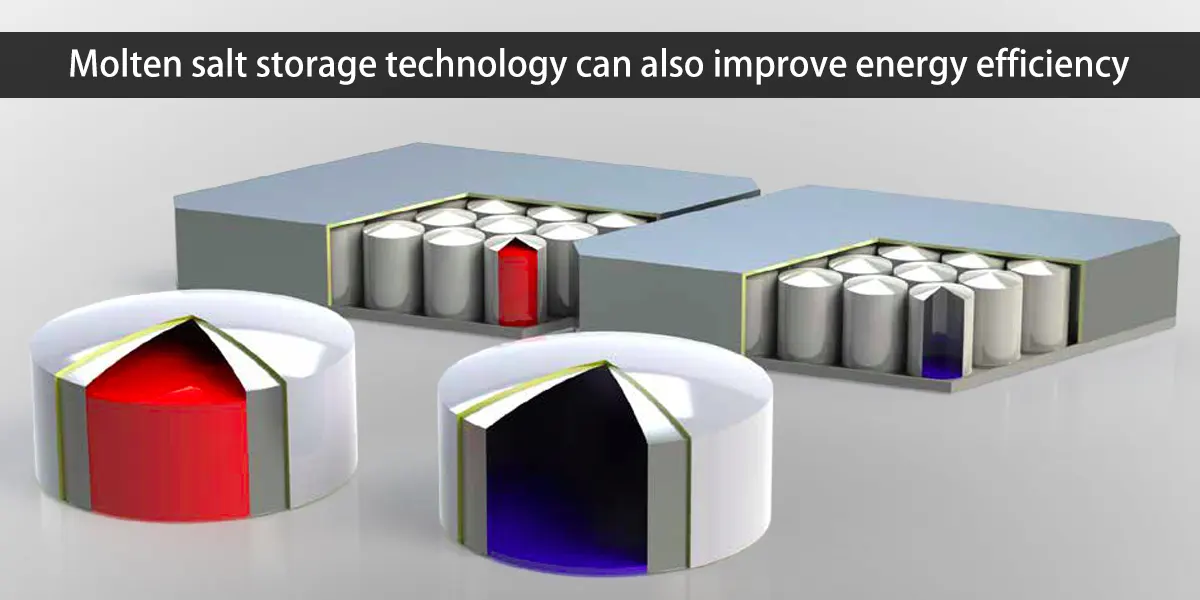
Molten salt stores energy by storing heat. If electrical energy needs to be stored, then the entire process needs to complete the conversion of “electrical energy – thermal energy – electrical energy”, which is very inefficient;
If what needs to be stored is thermal energy, the temperature difference during the heating and cooling processes can realize thermal energy storage. The whole process is the conversion of “thermal energy-electric energy”.
When power generation is needed, the molten salt in the high-temperature tank can be pumped out and exchange heat with water to generate steam. It drives the steam turbine to generate electricity with low loss and high efficiency.
Molten salt storage can be used in scenarios where thermal energy is used to generate electricity, such as photothermal power generation, thermal power plant renovation, etc.; or in scenarios where the terminal energy demand is thermal energy rather than electrical energy, such as clean heating.
- Applications in photothermal power generation systems:
CSP plants generally use a dual-tank system of hot salt tanks and cold salt tanks to store molten salt. The molten salt in the cold molten salt storage tank is transported to the solar collector through the molten salt pump. It absorbs heat energy and heats up before entering the hot molten salt storage tank.
Then the high-temperature molten salt flows into the molten salt steam generator to generate superheated steam to drive steam. Turbines run to generate electricity while the temperature of the molten salt decreases and flows back into the cold molten salt storage tank.
Molten salt integrates heat storage and heat transfer media into one, simplifying the composition of the power station system.
As a supporting energy storage facility for photothermal power generation, the molten salt thermal storage system can improve the utilization rate of solar energy, reduce power fluctuations, and promote stable output of the power grid.
For photothermal power generation, binary molten salt is widely used. The commonly used binary molten salt is a mixture of 60% sodium nitrate and 40% potassium nitrate.
- Providing thermal energy for industrial production
The molten salt heat storage system has high thermal energy utilization efficiency, can realize the recovery and utilization of waste heat and waste heat, and provides stable and continuous high-quality heat sources such as steam and hot air for food processing, textile and other enterprises in industrial parks.
- Energy storage in power stations
By installing molten salt heat storage equipment in a thermal power plant, it can be transformed into an energy storage peak-shaving power station, which can flexibly output electricity. The stored heat can be converted into steam to provide heat for users, improving the economic benefits of the power plant.

Molten salt storage is the third largest energy storage model in the world, and the market is currently on an upward trend. As of the end of 2022, the global cumulative installed capacity is 6.1GW, accounting for approximately 1.6% of the total installed energy storage capacity.
Spain, the United States, and China are the three major countries in the molten salt storage market. Spain and the United States have reached a certain market size, and the Chinese market has also shown significant growth momentum.
China’s molten salt storage installed capacity will be 0.52GW in 2022. In the long term, it is expected that by 2030, China’s molten salt storage installed capacity will exceed 16GW, with a total investment of more than 200 billion yuan.
The application scenarios of molten salt storage include solar thermal power generation, thermal power flexibility transformation, grid peak shaving and valley filling, valley power heating, waste heat recovery, abandoned power energy storage, etc.
Among them, photothermal power generation and flexibility transformation of thermal power units are application areas that require focus.
Molten salt has quickly become a new star in the development of new energy due to its unique energy storage advantages.
Molten salt storage can participate in the flexibility transformation of thermal power units, use valley power to heat molten salt thermal storage for industrial steam supply, use valley power to heat molten salt thermal storage for central heating (“coal to electricity”), use abandoned wind and abandoned photoelectricity to heat melts. Salt thermal storage heating, industrial waste heat utilization, etc.
Molten salt thermal storage can also be used in many fields such as seawater desalination, heavy oil mining, power grid peak shifting and valley filling, distributed energy, etc., and has broad development prospects.



 +86 – 18925002618