

The full name of mppt solar charge controller is “Maximum Power Point Tracking” solar controller, which is an upgraded product of traditional solar charge and discharge controller.
The mppt solar charge controller can detect the power generation voltage of the solar panel in real time and track the highest voltage and current value (VI), so that the system can charge the battery with maximum power output. Used in solar photovoltaic systems, it coordinates the work of solar panels, batteries, and loads and is the brain of the photovoltaic energy storage system.
To charge the battery, the output voltage of the solar panel must be higher than the current voltage of the battery. If the voltage of the solar panel is lower than the voltage of the battery, the output current will be close to 0. If you want to know about photovoltaic energy storage manufacturers, please click on Top 5 latest photovoltaic energy storage products in China.
Therefore, for safety reasons, when the solar panel is manufactured and shipped from the factory, the peak voltage (Vpp) of the solar panel is approximately 17V, which is set based on the standard when the ambient temperature is 25°C. When the weather is very hot, the peak voltage Vpp of the solar panel will drop to about 15V, but in cold weather, the peak voltage Vpp of the solar panel can reach 18V.
Now, let’s go back and compare the differences between mppt solar charge controller and traditional solar controller. The traditional solar charge and discharge controller is a bit like a manual gearbox.
When the engine speed increases, if the gearbox gear does not increase accordingly, the vehicle speed will inevitably be affected. But for mppt solar charge controller, the charging parameters are set before leaving the factory.
That is to say, the mppt solar charge controller will track the maximum power point in the solar panel in real time to maximize the solar panel efficiency. The higher the voltage, through maximum power tracking, more power can be output, thereby improving charging efficiency. Theoretically, the solar power generation system using mppt solar charge controller will increase the efficiency by 50% compared with the traditional one.
However, according to our actual testing, due to the influence of the surrounding environment and various energy losses, the final efficiency can also be increased by 20%-30%.
In this sense, MPPT solar charge and discharge controller is bound to eventually replace traditional solar controllers.

Compared with traditional solar controllers, mppt solar charge controller has the following advantages:
- Improve energy efficiency
Mppt solar charge controller can track the maximum output power of solar panels in real time, maximizing energy utilization efficiency. Under different lighting conditions, the mppt solar charge controller can automatically adjust the working point to ensure that the solar panels are always in the best working condition and maximize the collection and conversion of solar energy. - Increase system stability
Mppt solar charge controller adopts advanced electronic adjustment technology and has high stability and reliability. It can automatically adapt to different light and temperature changes, and can effectively resist the impact of panel output voltage fluctuations and load changes, ensuring the stable operation of the solar system. - Provide a variety of protection functions
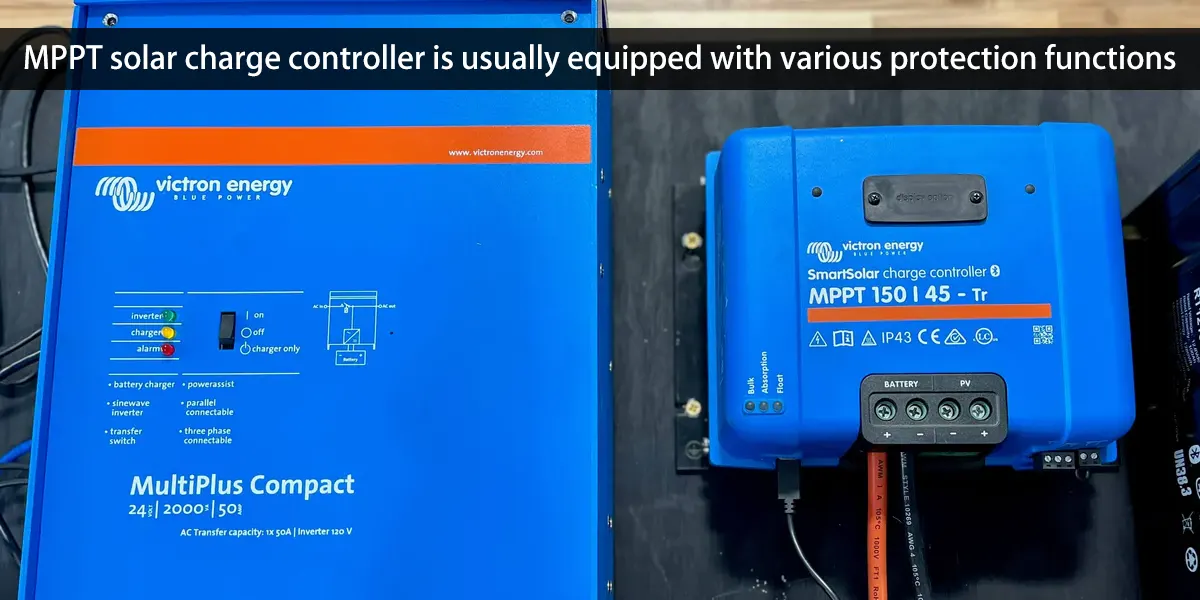
MPPT solar charge controller usually has a variety of protection functions, such as overvoltage protection, overcurrent protection, short circuit protection, etc., which can effectively protect solar panels and batteries from damage and extend the service life of the system.

- Photovoltaic array polarity reverse protection When the photovoltaic array polarity is reversed, the controller will not be damaged and will continue to work normally after correcting the wiring errors.
- Battery polarity reverse protection When the battery polarity is reversed, the controller will not be damaged and will continue to work normally after correcting the wiring error.
- Battery overvoltage protection When the battery voltage reaches the overvoltage cut-off voltage point, the controller will automatically stop the battery charging to prevent damage to the battery due to overcharging.
- Battery over-discharge protection When the battery voltage reaches the low-voltage disconnection voltage point, the controller will automatically stop discharging the battery to prevent damage to the battery due to over-discharge.
- The battery over-temperature protection controller detects the battery temperature through an external temperature sensor. When the temperature of the battery exceeds 65℃, it will stop working and resume working when it is below 55℃.
- Load overload protection If the current of the load exceeds 1.05 times the rated current of the controller, the controller will disconnect the load after a delay.
- When an overload occurs, after the fifth time the controller automatically restores the output and becomes invalid, the protective action must be eliminated by reducing the electrical equipment at the load end by pressing the SET button or restarting the controller or changing from night to day (night duration > 3 hours).
- Load short circuit protection When a short circuit occurs at the load end (≥4 times the rated load current), the controller will automatically cut off the output. After five automatic recovery outputs, if the controller restarts the automatic recovery process, it must go through changes from night to day. (Night duration > 3 hours)
- Either restart the controller or press the SET button. It is recommended to disconnect the photovoltaic array terminal first and then disconnect the battery terminal to restart the controller. Temperature sensor damage protection When the temperature sensor is short-circuited or open-circuited, the controller will charge or discharge at a default temperature of 25°C to prevent overcharging or over-discharging from causing damage to the battery.
- Controller over-temperature protection The controller detects whether the temperature exceeds 85°C through an internal sensor for automatic protection. It will stop working when the internal temperature exceeds 85℃ and resume working when it is below 75℃.
- High-voltage surge protection This controller can only protect high-voltage surges with small energy. In areas with frequent lightning, it is recommended to install an external lightning arrester.

With the continuous advancement of energy storage technologies and the rapid development of the renewable energy market, mppt solar charge controller will usher in more innovations and improvements in the future. This will bring greater impetus to the promotion and application of renewable energy and contribute to the realization of a clean and sustainable energy future.



 +86 – 18925002618