




As the dividends from the skyrocketing energy prices brought about by the Russia-Ukraine conflict have faded, and market competition has become increasingly fierce, the energy storage market has fallen into an oversupply dilemma within a short period of time. Coupled with the continued decline in global lithium carbonate prices in 2023, top bess suppliers that manufacture energy storage products bear greater costs when prices are high.
But for now, the three main application scenarios of portable storage are outdoor. It is used to provide functions for digital products such as mobile phones and cameras. It can also provide short-term power supply for electric appliances such as rice cookers and lighting fixtures, and can even provide temporary power supply for vehicle ignition starting, emergency lighting, etc.
In addition, in the emergency field, portable energy storage can be used as home emergency power supply to cope with temporary power outages due to emergencies. In other areas, it can also be used to charge vehicles and provide electricity in areas where electricity is scarce.
However, the problem is that these areas that can accommodate portable energy storage are basically occupied at present. The next step is just to improve the penetration rate. According to the data, by 2026, the penetration rate of portable energy storage products in the field of outdoor activities can reach 15.9%, and the penetration rate in the field of emergency power can reach 19.4%.
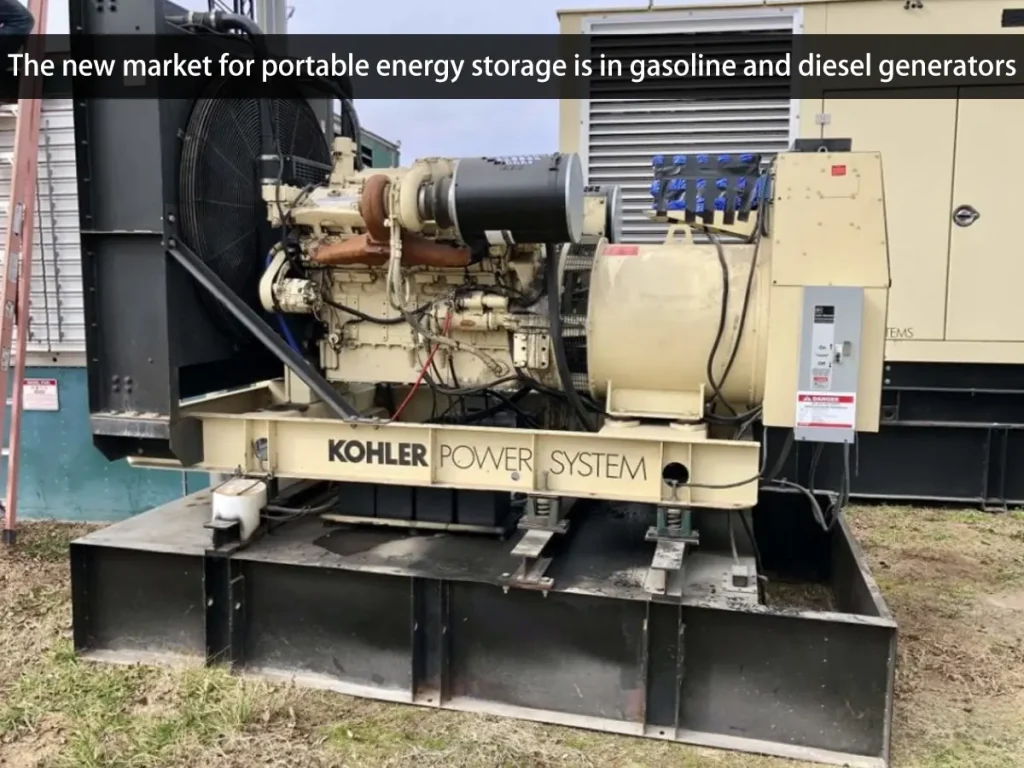
From the perspective of growth rate, it can basically maintain an increase of more than 30% every year, but compared with new players and more competitive markets, this increase is slightly insufficient. So is there a new market space for portable energy storage equipment? The gasoline and diesel generator market can be perfectly replaced by portable energy storage.
In terms of market size, taking diesel generators as an example, public information shows that the global diesel generator market size was US$12.625 billion in 2020, a year-on-year increase of 12.7%, and will reach US$13.952 billion in 2021, a year-on-year increase of 10.5%. It is expected to reach US$13.952 billion in 2025, a year-on-year increase of 10.5%. This market size is expected to reach more than 20 billion US dollars in 2018, which of course includes large generating units and small generating units.
In the context of low-carbon development, portable energy storage is expected to accelerate the replacement of these gasoline and diesel generators. Compared with traditional diesel generators, portable energy storage equipment has many performance advantages such as light weight, high power generation quality, and low maintenance costs.
In addition, regions such as California in the United States have made it clear that the sale of fuel-driven equipment, including fuel generators, will be banned from January 1, 2024, which will inevitably accelerate the replacement of gasoline and diesel generators with portable energy storage. It is predicted that by 2026, the replacement proportion of diesel generators by portable energy storage solution is expected to increase to 18.6%.
The huge market for gasoline and diesel generators also means that the portable energy storage market is expected to reach the same order of magnitude in the future. Such a huge market has also attracted many domestic and foreign companies to compete for layout.
In addition to its large scale, the gasoline and diesel generators themselves emit huge noise, exhaust gas and huge amounts of carbon emissions during operation, and are obviously not suitable for continued promotion today. The market needs a green, clean energy source to replace the current gasoline and diesel generators. For example, the German startup Instagrid has successfully attracted the attention of investors through innovative small energy storage systems that replace traditional fuel generators. Instagrid recently completed a $95 million Series C financing.
According to data from Instagrid’s official website, its products have zero exhaust emissions and a carbon footprint that is 97% lower than that of gasoline and diesel generators. The company’s flagship product has sold nearly 30,000 units in 29 countries. At the same time, the company’s performance revenue in 2023 has more than doubled, directly verifying the popularity of the market for replacing gasoline and diesel generators.
Including Ampd Energy, a startup in Hong Kong, also completed an $8 million Series A financing in June last year. The company mainly focuses on replacing gasoline and diesel generators with batteries. According to the company, there are currently about 10 general construction projects in Hong Kong using Ampd’s energy storage systems to generate electricity.
Despite the promising prospects, there are still some challenges before portable energy storage can completely replace gasoline and diesel generators. For example, as a traditional power generation method, gasoline and diesel generators have the advantages of large output power, long continuous power supply time, and wide application range. Therefore, they can be used in some scenarios that require large amounts of power supply, such as large construction sites, field exploration, remote areas, etc. , remains irreplaceable.
In addition, in some scenarios that require high power supply stability, such as hospitals, data centers, etc., reliable power generation equipment such as gasoline and diesel generators are also required, unless the gasoline and diesel generators can solve the problems of power generation and continuous charging.
For example, the current capacity of many portable energy storage devices is around 2-3 kilowatt-hours. If the capacity increases, its weight will also increase simultaneously. Unless more devices are used in parallel, the battery life will only be a few kilowatt-hours and can only supply other products. The equipment operates for a short period of time.
Another bigger problem is that, although costs are gradually decreasing, the initial investment cost of high-performance portable energy storage equipment may still be higher than that of traditional fuel-fired generators. Portable energy storage equipment not only needs to provide stable power output, but also needs to meet various performance requirements such as safety, portability, stability and environmental protection. The improvement of these comprehensive performance will also increase the design and manufacturing costs of the product.
For industrial applications, power generation products must at least be waterproof and dustproof, have high power, high durability and low cost. However, portable energy storage is obviously not possible at present. The power is small, the price is high, and the products are not durable. Resistance.
In terms of purchase cost, portable energy storage basically reaches 1,000Wh/3,000 yuan, while a diesel generator costs about 2,000 yuan per unit. In terms of usage cost, the charging cost of portable energy storage is about 0.5 yuan per kilowatt hour, while the diesel generator set can generate 10kWh of electricity per liter, and the cost of electricity per kilowatt hour is about 0.7 yuan.
Coupled with the high energy density batteries of portable energy storage itself and the high R&D and manufacturing costs, portable energy storage is more expensive to use than diesel generators. To solve this problem, we can only wait for technological breakthroughs. Or achieve scale in the future to reduce costs.



 +86 – 18925002618





