


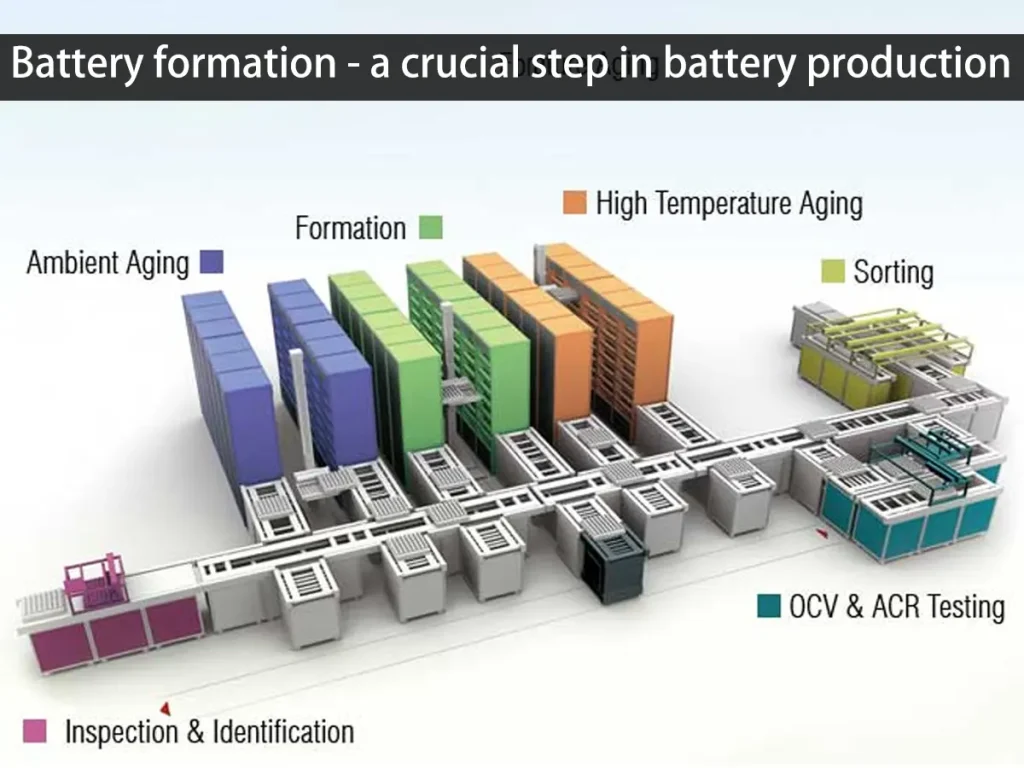


Lithium battery formation is the first battery charging process after the lithium battery is filled with liquid. This process can activate the active materials in the battery and activate the lithium battery. At the same time, a side reaction occurs between the lithium salt and the electrolyte, forming a solid electrolyte interface (SEI) film on the negative electrode side of the lithium battery. This film can prevent further side reactions, thereby reducing the loss of active lithium in the lithium battery. The quality of SEI has a great impact on the cycle life, initial capacity loss, rate performance, etc. of lithium battery cells.
According to the different conditions such as temperature, current, and liquid injection port during the formation of lithium batteries, the formation process can be divided into the following categories:
- High-temperature formation: During the charging and discharging process, the battery core is always in a high-temperature environment. High temperature can increase the electrochemical reaction rate and SEI film forming rate. The formed SEI film has high consistency but is loose and unstable.
- Low-temperature formation: During the charge and discharge process, the battery core is always in a low-temperature environment. The SEI film formed during the low-temperature process is dense and stable, but the reaction rate is slow and the formation time is long.
- Large current formation: During the formation process, the charge and discharge current is always at a larger current such as 0.5C, 1C, 2C. Large current can increase the electrochemical reaction rate and SEI film forming rate, but the consistency of the SEI film formed is not high.
- Small current formation: During the formation process, the charge and discharge current is always at a smaller current such as 0.02C, 0.05C. The SEI film formed during the low current process is dense and stable, but the reduction in reaction rate will prolong the formation time.

- Open formation: During the charging and discharging process, the cell liquid injection port is always open at normal pressure, and the gas generated by the electrochemical reaction can be eliminated in time, which improves the consistency of SEI film forming. The formation equipment is simple and low-cost but requires a long standing time and high environmental humidity conditions.
- Closed-hole formation: During the charging and discharging process, the cell liquid injection port is always in a sealed state, and the formation process does not require environmental humidity conditions. However, the formation process of the equipment is complex, and the battery shell has the risk of plastic deformation.
- Negative pressure formation: During the charging and discharging process, the battery core is evacuated from the liquid injection port to -80KPa. Negative pressure formation can eliminate the generated gas in time, ensuring the stability and consistency of the SEI film. However, the formation equipment is complex and requires high air tightness. In addition, electrolyte loss will occur during the vacuuming process.

Different battery formation conditions have different effects on battery performance, here will be introduced in detail next:
Formation current density: high current density and rapid formation of crystal nuclei will cause the structure of the SEI film to be loose and not firmly attached to the surface of the negative electrode. On the contrary, at low current density, the formation speed of crystal nuclei is slow, and the structure of the SEI film is denser. However, an SEI film with a loose structure can infiltrate more electrolyte, so that the ion conductivity of the SEI film formed under high current density is greater than that of the SEI film formed under low current density.
Formation cut-off voltage: As charging proceeds, the internal voltage of the battery increases, accompanied by gas generation. Once the gas production rate is higher than the exhaust rate of the liquid injection hole, the gas will accumulate between the separators inside the battery, resulting in uneven contact between the separator and the negative electrode surface, thus affecting the embedding process of lithium ions on the negative electrode surface. Therefore, appropriately reducing the formation voltage can improve the first charge and discharge efficiency of the battery, reduce the internal resistance of the battery, and improve the battery cycle performance.
Formation temperature: On the one hand, temperature affects the formation rate and composition of the SEI film; on the other hand, some components of the SEI film will decompose at high temperatures, causing the SEI film to rupture, which will further consume lithium to form a new SEI film.
External pressure: Gas will be generated during the formation process. If the gas is not eliminated in time, the lithium ion transmission distance will be increased, the impedance will increase, and the battery charging capacity will decrease. If appropriate rolling pressure is added during charging, it can help eliminate gas, which will not only increase the battery formation capacity, but also significantly improve the battery’s rate and cycle performance.
- The first step is battery hibernation.
- The second step is constant current charging.
Charge at 0.02C constant current for 270 minutes. The purpose of low current charging is to make the quality and interface of the SEI film better. However, the formed SEI film is unstable and easily reacts with the previous decomposition products. Further charging is required to stabilize the SEI film. - The third step is battery hibernation.
The purpose is to make the two charges have a conversion process and achieve the effect of eliminating polarization; - Step 4: Constant current charging
Charge to 3.95V at 0.1C. After the SEI film is basically formed, charge with a slightly larger current. This not only saves more time, but also forms a dense SEI film with better thermal stability. At this time, the SEI film combines the electrolyte and graphite. Completely separated, only ions are allowed to pass to the graphite layer. However, the voltage cannot be charged too high at this time, which may cause lithium precipitation.

In the production of top bess suppliers, only energy storage cells that pass battery formation testing can be transported to all parts of the world.



 +86 – 18925002618





