


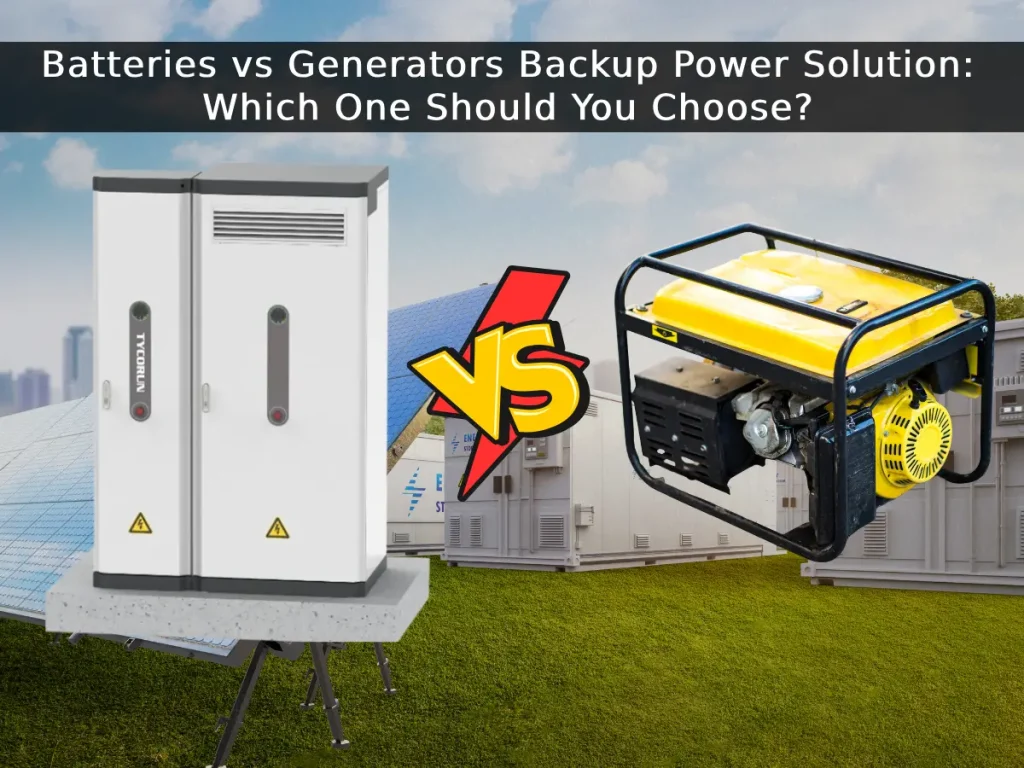
Power outages are a common occurrence in homes, offices, and industrial facilities. When the power goes out, all activities in progress are suddenly disrupted. Therefore, many people have started using backup power solutions to keep the lights on during power outages. The most common comparison is between batteries vs generators backup power solution
Both systems, although both can be used for backup power, have different characteristics and operating mechanisms. In this article, we will discuss batteries vs generators backup power solution in more detail. Users will discover the advantages and disadvantages of both systems and also how to select the one that best meets their requirements.
What Are Battery Backup Systems?
Before discussing in more detail the comparison between batteries vs generators backup power solutions, it is important to first understand what a battery backup system is. A battery backup system is a device for storing backup electricity. This device does not consist only of batteries. Rather, it is a complete system consisting of batteries, inverters, and control components that make everything automatic.

This battery backup system works by storing electrical energy in advance. Then, when a power outage occurs, the system will automatically release the electricity so it can be used. In addition, battery backup systems have the advantage of being quiet and low in gas emissions, making them more environmentally friendly. Another advantage of battery backup systems is that many batteries can be connected to solar panels. So they can be charged using solar power.
Looking for more insights? Read our full write-up on Home Standby Generators vs Battery Backup Systems
What Are Generators for Backup Power?
A backup power generator is a backup power source that existed before backup batteries. Unlike backup batteries, which store electrical energy, generators actually produce electricity from fuel such as gasoline, diesel, or gas. So when the main power goes out, users can turn on the generator to supply electricity to their homes, offices, or even large facilities.

Generators are known for their power and durability. This is because, as long as fuel is available, users can use generators for hours or even days. Therefore, in the comparison between batteries vs generators backup power solutions, generators are often considered a more suitable choice for large-scale needs.
How Batteries and Generators Work
Behind the comparison between batteries vs generators backup power solutions, the main difference lies in how these two devices work.

- How Battery Backup Works
A battery backup system works by storing electrical energy first, then releasing it automatically when the main power goes out. Because battery backup systems can be connected to solar panels, these systems can store energy more flexibly as they can store energy directly from solar power. Therefore, this system is more economical and environmentally friendly.
Curious to know more? See our explanation of How should solar batteries be stored here - How Generators Work
Generator backup solutions are very different from battery backup systems. This is because generators are not designed to store electrical energy, but rather to generate electricity when turned on. Generators work by converting fuel into mechanical energy through an engine. The engine then generates electricity and distributes it to devices. Therefore, generators can always be used as long as there is fuel available.
In other words, a battery backup system is a reserve for storing electricity that can be used anytime, while a generator is a machine that is run when the user needs electricity.
Pros and Cons of Batteries vs Generators Backup Power Solutions
When choosing between batteries vs generators backup power solutions, it is important for users to understand the advantages and disadvantages of each system. By understanding the advantages and disadvantages of both systems, users can choose the one that suits their needs.

Pros of Battery Backup
- Quiet & practical
Battery backup power does not use combustion engines like generators, so it is silent. In addition, these batteries are equipped with automatic controls, which allow the system to turn on automatically without any noise. - Environmentally friendly
Battery backup power is not only quiet, but also environmentally friendly. This is because there is no smoke or emissions from fossil fuels. - Can be connected to solar panels
Many modern backup batteries can be connected directly to solar panels. This means that the energy source can be more efficient, cleaner, and not solely dependent on the main electricity supply. - Minimal maintenance
Modern backup batteries do not have moving parts like generators, so they do not require routine servicing to change oil or check the engine.
Cons of Battery Backups
- High initial cost
Battery backups use modern technology, so the initial price for users is higher than that of generators. - Limited duration
Battery backup power systems rely on stored battery capacity, so their duration is limite. - Decreased service life
Over time, battery performance can decrease due to repeated cycles.
Pros of Generator
- High power
Generators can produce large amounts of electricity through combustion engines. These engines convert fuels such as gasoline, diesel, or gas into electrical energy. - Long Operation Time
Generators can be used for days on end because they use fuel to power their engines. As long as there is fuel, the generator will continue to run. - Lower initial cost
Generators are more affordable than backup systems with large battery capacity
Cons of Generators
- Noisy
Generators work by using combustion engines that convert fuel into electrical energy. These engines produce quite a lot of noise. - Emissions
Because generators work using fossil fuels, they produce smoke and exhaust gases. - Requires routine maintenance
Generators require routine maintenance, such as oil changes, engine servicing, and filter checks. - Not automatic
Since generators do not have automatic controls like battery backups, they must be turned on manually.
Applications of Batteries vs Generators
In understanding batteries vs generators backup power solutions it is also important for users to know where these two systems are applied. The following is a comparison of the applications of Batteries vs Generators backup Power Solutions:

| Application | Battery Backup Power | Generators |
|---|---|---|
| Homes & Offices | Batteries are quiet and practical, plus they can connect to solar panels, so they are great for daily needs without disturbing noise. | Generators can also be used, but they are noisy and less comfortable for residential environments. |
| Hospitals & Data Centers | Batteries provide stable power that is emission-free and silent, which makes them perfect for sensitive equipment. | Generators are less ideal in this case because they produce vibration, noise, and fuel emissions. |
| Industries & Factories | Batteries can work as an additional backup, although their capacity is more limited. | Generators are more reliable here since they can produce large amounts of power to keep heavy machinery running. |
| Construction & Remote Sites | Batteries may be harder to use if the site is far from the grid or lacks solar panels | Generators are very suitable because they can run continuously as long as fuel is supplied. |
| Renewable Energy Systems | Batteries are easy to integrate with solar panels so they can store clean and sustainable energy. | Batteries are easy to integrate with solar panels so they can store clean and sustainable energy. |
Looking for more insights? Read our full write-up on industrial energy storage
Choosing the Right Backup Power Solution
When choosing between batteries vs generators backup power solutions, users can consider the following:

- Choose Batteries
Batteries can be an option for users who need a backup power supply that can turn on automatically when the main power goes out. In terms of noise, this backup battery system is ideal for homes, offices, healthcare facilities, or places that need stable power without noise. In addition, this system can also be connected to solar panels, so for users who need a more environmentally friendly system, a backup battery system is the right choice.
Learn more in our article on What is Solar Batteries Storage? - Choose Generators
Meanwhile, generators can be used for users who need high power and long usage times. So, generators are usually chosen by users for use in construction or industrial projects. In addition, they are often used in remote locations because fuel is easier to obtain than electricity.
By understanding the comparison between batteries vs generators backup power solutions, users can more easily determine the most suitable backup power solution for their daily needs.
Conclusion
Understanding batteries vs generators backup power solutions not only helps users understand the differences between how these two systems work, but also helps users determine which backup power solution to choose.
Batteries are a backup power source with an automatic control system that allows electricity to turn on immediately when the main power goes out. In addition, this system does not produce noise or smoke when operating. Batteries can also be connected to solar panels, allowing users to utilize a more environmentally friendly backup system.
Meanwhile, generators are devices that are turned on to obtain backup electricity. These devices are powered by fuels such as gasoline or gas, which are converted into electrical energy. Although they are noisy, these systems have high power and a long operating time as long as fuel is available. This makes them ideal for use in construction or industrial settings. Lorem ipsum dolor sit amet, consectetur adipiscing elit. Ut elit tellus, luctus nec ullamcorper mattis, pulvinar dapibus leo.
FAQS
It depends on the situation. Batteries are better if you need quiet, clean, and automatic backup power. Generators are better if you need high power for long hours.
Yes, but only in certain cases. A battery backup can replace a generator for homes, offices, or smaller facilities. For factories, long outages, or heavy use, a generator is still more reliable.
Battery backups usually last a few hours to a full day, depending on their capacity. Generators can run much longer, even for several days, as long as there is enough fuel.


 +86 – 18925002618





