



Global energy storage market analysis
European energy storage market
The installed capacity of household storage in Europe is on the rise. In 2021, European household storage will reach 2,045MWh, a year-on-year increase of 73%. The average annual compound growth rate in 2015-21 will reach 63%, which is a very fast growth.
Among them, Germany has the largest increase in European household storage. In terms of power, in 2021, the installed capacity of German household storage will reach 1,479MWh, accounting for 72% of European household storage, followed by Italy (191MWh), the United Kingdom (81MWh), Spain (48MWh), and France (35MWh), accounting for 90% in total.

Us energy storage market
The United States is the second largest market for household energy storage in the world, and California is the main contributor to household energy storage installations. The demand for household storage in the United States is strong.
In 2021, the installed capacity of household storage will reach 468MWh, a year-on-year increase of 110%. The growth rate in the past three years has remained above 26%. At the same time, in 2020, California’s household energy storage installed capacity accounted for 57%.
In 2021, the newly installed capacity of energy storage in the United States will be 3971MW/10880MWh, and the installed capacity will increase by 341% year-on-year. Among them, household energy storage added 343MW/960MWh, accounting for 8.8% of the total newly installed energy storage capacity.
The Energy Storage Association of the United States believes that by 2025, the installed capacity of energy storage systems deployed in the US energy storage market will increase fivefold. Among them, user-side energy storage systems continue to form a major part of this growth.
Australian energy storage market
First of all, in terms of policy support, Australia has introduced small-scale renewable energy plans and FiT subsidy policies to promote the installation of solar storage; secondly, in terms of lighting and installation conditions, Australia has sufficient lighting resources, high photovoltaic power generation efficiency, large land and sparse population, and residential buildings.
Most of them are villa-type, suitable for installing photovoltaics, and the home storage system is highly economical.
In 2021, Australia will achieve household storage and installed capacity of 206MW/494MWh, a year-on-year increase of 45% in terms of MWh. Major suppliers include Tesla, Alpha ESS, Growatt, etc. Tesla ranks first in terms of market share.
China energy storage market
China’s energy storage installed capacity is growing rapidly, mainly from centralized. China’s installed capacity of energy storage has been growing rapidly in the past two years. In 2021, the newly installed capacity of energy storage will reach 2.45GW/4.61GWh, a year-on-year increase of 79%/86%. The main contribution comes from China’s centralized energy storage installed capacity.
Distributed energy storage is still in the early stages of development, and the economy is not high. In 2021, the installed capacity of distributed energy storage will be 188MW/333MWh, +11%/-30% year-on-year, and centralized energy storage will account for over 90%.
Judging from the shipments of the top ten Chinese-made inverters and energy storage battery manufacturers in China and the world in 2021, the energy storage inverters and batteries made in China are mainly for global customers.
Among which the global energy storage inverter leading companies Sungrow’s global shipments are about 2.5GW, with exports accounting for more than 90%; CATL, the global leader in energy storage batteries, has global shipments of about 16.5GWh, with exports accounting for more than 88%.

The battery pattern of global energy storage
Global energy storage pattern
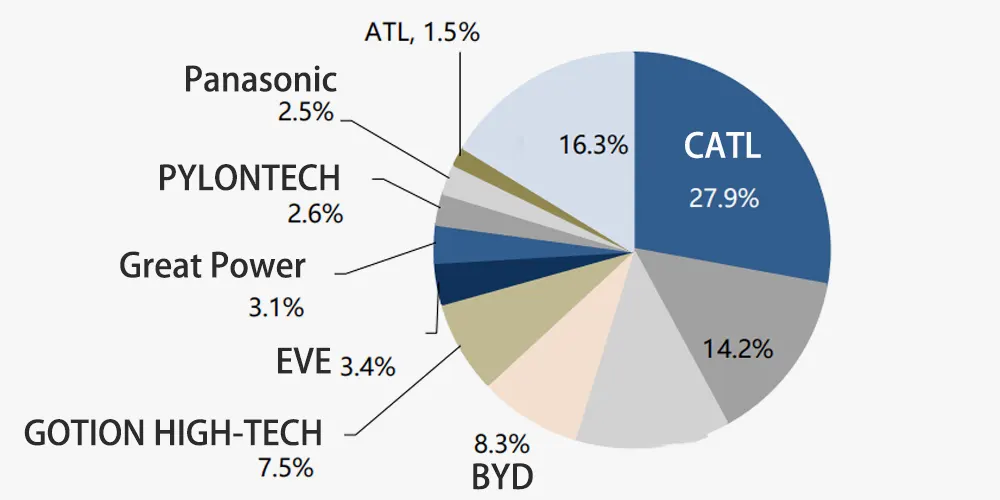
Globally, Chinese manufacturers of energy storage batteries are leading in shipments, and CATL ranks first in the world in terms of shipments. According to estimates, the global shipment of energy storage cells in 2021 will be 59.9GWh, of which CATL will occupy the top spot as the largest battery cell supplier, with shipments of 16.7GWh, accounting for 27.9%; 1.5GWh, accounting for 2.6%.
It is estimated that the global energy storage battery shipments will be 117.2/182.1GWh in 2022-2023, a year-on-year increase of 93%/55%. Among them, CATL occupies the top spot as the largest battery supplier, and CATL is expected to ship in 2022-2023 45.0/67.5GWh, a year-on-year increase of 169%/50%, accounting for 38.4%/37.1%.
Inverter pattern of global energy storage
The pattern of household storage inverters is relatively concentrated, and the competition among manufacturers is fierce. CR5 accounts for about 58%, and the energy storage shipments of leading inverter manufacturers are all growing rapidly. In 2021, the global user-side energy storage inverter market will have relatively concentrated competition, but the competition among manufacturers will be fierce.
Growatt ranks first, with a market share of about 13.8%. Deye, Ginlong, Solaredge, GoodWe Followed closely by 12.4%, 10.9%, 10.3%, and 9.8%, respectively. The differences in the top five market share are small, and CR5 accounts for about 58%.

Global new type of energy storage basic research dynamics and technological development trends
Frontier topics of global energy storage basic research
The number of papers published in the global new energy storage basic research has grown rapidly in the past 10 years, among which the number of papers published in the field of lithium-ion batteries is the largest (accounting for 73.4%).
Especially in the past two years, the number of global new energy storage publications accounted for 41.9% of the total in the past 10 years, of which metal-air batteries and gravity energy storage technologies accounted for more than 50%.
Major countries in the world have carried out extensive research in the field of new energy storage, and China has performed particularly well, ranking first in the world with 70,091 publications (accounting for 53.5%), followed by the United States (16.6%) and South Korea (8.4%).
Key directions of new energy storage technology layout
- In the past 3 years (2020-2022), 6 new energy storage technology-related patents have been analyzed by topic clustering and word cloud, and the technical layout is as follows:
Cyclic stability materials, including negative electrode materials, positive electrode materials, lithium battery separators, and precursor materials, thermal runaway, etc. - synthesis process, such as prediction model, electrochemical model, etc.
- lithium battery, focusing on lithium battery packs, electrode materials, etc.
- sodium ion battery, including positive electrode materials, electrolyte additives, solid electrolyte materials, etc.
- Physical energy storage system, focusing on compressed air energy storage, gravity energy storage, etc.
Global energy storage market demand forecast and battery technology development trend
Estimation of the global energy storage market in the future
With the globalization of energy transformation, electrical energy storage has become more popular in the market in recent years, superimposed on the policy guidance of various countries, the energy storage market will show an explosive trend in 2022, and the shipment of large energy storage will increase by 158% year-on-year.
It is estimated that in 2023, the demand for energy storage market will be strong and still maintain rapid growth; at the same time, various companies will go other countries to seek high-profit orders.
By 2024, the explosive demand will still be warm, and the planned production capacity of various enterprises will be gradually released, and a new generation of products will gradually enter the market for competition.
By 2025, it is expected that the growth rate of the energy storage market will gradually slow down, and the first round of competition for new products and cost reduction and efficiency enhancement of old products will become the main theme of competition among enterprises.
By 2030, the demand for new energy storage in China and the United States will exceed 400GWh, and the demand for new energy storage in Europe may reach the level of nearly 300GWh. In terms of new global energy storage demand, it is estimated that by 2030, the global energy storage demand may be as high as 1300GWh or more.
Development trend of battery technology in global energy storage market
At present, the technical development path of the electric energy storage market is mainly the battery capacity of 280Ah. It is predicted that the capacity of the battery cells will be gradually increased in the future (priority is to increase the cycle and then increase the capacity under the premise of ensuring stable size).
In the future, both 560Ah and 150Ah cell capacities are likely to occupy a place in the market. However, the battery capacity of around 300Ah is still the mainstream in the future. In addition, after 2025, all-vanadium flow batteries and sodium-ion batteries will enter the market.


can a hybrid inverter work without a battery? Yes, it can operate in a grid-connected setup to supply power directly from solar energy, but without storage, it cannot provide backup power or store excess energy, making a battery a valuable upgrade for better efficiency and reliability.

Lithium batteries do not emit harmful radiation. They operate through safe chemical processes, making them reliable and widely used for modern energy storage systems

Rechargeable batteries vs regular batteries differ in efficiency, lifespan, and application. Rechargeable batteries support repeated use and continuous energy storage, making them ideal for long-term and high-demand systems, while regular batteries are limited to single-use, short-term applications.

 +86 – 18925002618





