



Flywheel energy storage is a mechanical storage device that realizes the mutual conversion and storage of electrical energy and mechanical kinetic energy of a high-speed rotating flywheel through an electric/generating reciprocal bidirectional motor. The energy stored in the flywheel is based on the rotating mass principle. The input energy for a flywheel energy storage system usually comes from the grid or any other source of electrical energy. The flywheel is connected coaxially with the motor, showing that controlling the motor can control the flywheel.
The spinning flywheel is driven by an electric motor, exchanging electrical energy with mechanical energy and vice versa. When the flywheel is storing energy, the motor drives the flywheel to accelerate, and the electrical energy is converted into kinetic energy; when the energy is released, the flywheel drives the motor to generate electricity, the flywheel decelerates, and the kinetic energy is converted into electrical energy.
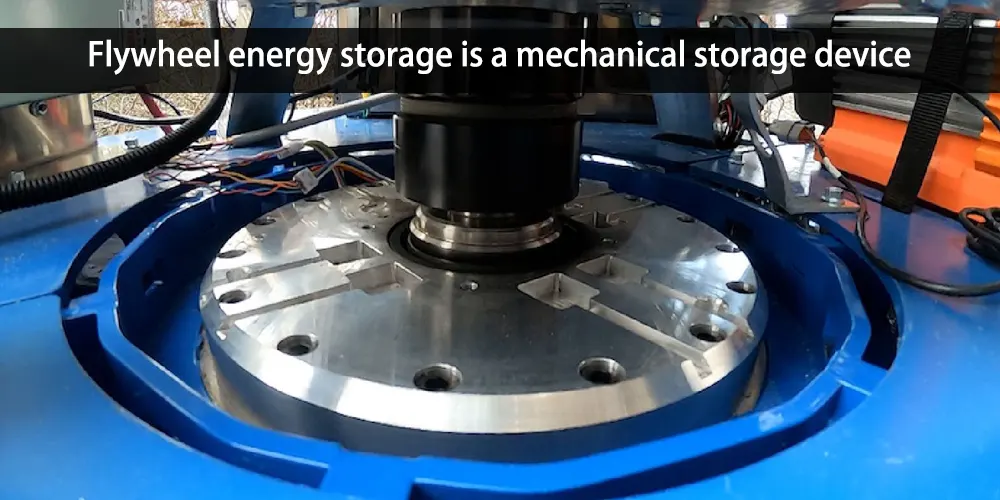
The flywheel energy storage system is composed of flywheel rotor, motor, bearing, power electronic interface and casing.
- flywheel rotor
The energy stored in a flywheel is determined by the shape and material of the rotor. Energy is linearly proportional to the moment of inertia and the square of its angular velocity, so the stored energy of a flywheel can be optimized by either increasing the rotational speed or increasing the moment of inertia. This provides two options for flywheel storage systems: low speed flywheel storage systems (typically up to 10,000rpm) and high speed flywheel storage systems (up to 100,000rpm).
Low speed flywheels are usually made of heavier metal materials and are supported by mechanical or magnetic bearings. High-speed flywheels generally use lighter but stronger composite materials and typically require magnetic bearings. High speed flywheels can often cost up to 5 times the cost of low speed flywheels.
- motor
The electric/generating reciprocal bidirectional motor is coupled with the flywheel to realize the energy conversion and battery charging process of the flywheel. This machine acts as a motor, storing kinetic energy for the flywheel by accelerating it and drawing electricity from the power source.
The energy stored on the flywheel is extracted by the same electric motor that acts as a generator, so the flywheel slows down in the process of converting kinetic energy into electricity. The motors commonly used in flywheel energy storage systems are induction motors (IM), permanent magnet motors (PM) and variable reluctance motors (VRM). Induction motors are used in high power applications due to their robustness, high torque and low cost. Speed limitations, complex controls and higher maintenance requirements are the main problems with induction motors.
- Double-fed induction motors (DFIMs) are currently used in flywheel energy storage system applications due to their flexible control and lower power conversion ratings, thereby reducing the size of power electronics.
- The variable reluctance motor has the characteristics of stable performance, low idle loss and wide speed range. For high-speed operation, variable reluctance motors have a simpler control mechanism than induction motors. Its disadvantages are low power factor, low power density and large torque fluctuation. Both switched reluctance and synchronous reluctance are suitable for high-speed flywheel energy storage systems.
- Permanent magnet motor has high efficiency, high power density and low rotor loss, and is the most commonly used motor for flywheel energy storage systems. It is widely used in high-speed applications. The main problems of permanent magnet motors are idling loss due to stator eddy current loss, high price and low tensile strength.
- Brushless DC motors (BLDCM), permanent magnet synchronous motors (PMSM), and Halbach array machines (HAM) are the main types of permanent magnet motors used in flywheel energy storage system applications.
- bearing
Flywheel energy storage requires bearings to hold the rotor in place with very low friction while providing the supporting mechanism for the flywheel. Bearing systems can be mechanical or magnetic, depending on weight, life and lower losses.
Mechanical ball bearings are traditionally used, but compared to magnetic bearings, mechanical ball bearings have higher friction and require higher maintenance costs due to lubricant degradation. These deficiencies can be mitigated by using a hybrid system of magnetic and mechanical bearings. Magnetic bearings have no frictional losses and do not require any lubrication.
Permanent (passive) magnetic bearings (PMB), active magnetic bearings (AMB) and superconducting magnetic bearings (SMB) are the main types of magnetic bearing systems.
- PMB has high stiffness, low cost and low loss. However, PMBs have limitations in providing stability and are generally considered as auxiliary bearing systems.
- The AMB is driven by a magnetic field generated by a current-carrying coil that controls the rotor position. The cost of AMB is high, the control system is complex, and energy is consumed during operation, which increases system loss. To ensure good efficiency of the overall system, a compromise must be made between speed and losses.
- SMB provides high speed, no friction, long life, compact and stable operation. It is the best magnetic bearing for high speed operation as it stabilizes the flywheel without electrical power or positioning systems. However, SMB requires a cryogenic cooling system because it operates at very low temperatures; but in recent years, it has been improved by using high-temperature superconductors (HTS). The main disadvantage of the SMB system is that it is very expensive.

- Rail Transit
The advantages of high power density and high efficiency of flywheel energy storage perfectly fit with the rail transit system, and its energy-saving effect far exceeds that of other energy-saving equipment.
In the operating costs of urban rail transit such as subways, electricity costs account for about 40%, and train traction power accounts for 45%-60% of the total electricity cost of subway operations, of which 17% is recyclable regenerative braking energy. The recovered braking energy is generally consumed by resistance heat dissipation, which has the problems of resource waste and impact on the power grid. The use of flywheel energy storage device can save 15% of traction energy consumption.
- Power grid
Flywheel energy storage has high power, fast response, and long life, and is suitable for power grid peak regulation and frequency regulation.
Some European countries have applied flywheel energy storage systems to power grid peak regulation and frequency regulation. At present, many places in China have launched flywheel energy storage projects for power grid peak regulation and frequency regulation. The pace of flywheel energy storage applications in power grid peak regulation and frequency regulation is expected to continue to accelerate.
- UPS uninterruptible power supply
UPS energy storage supply in the power system, there are a large number of users who have high requirements for power quality, such as semiconductor manufacturing, computer systems in banks, communication systems, precision medical equipment in hospitals, etc. When the external power grid is interrupted or the quality of power supply is abnormal, in order to ensure continuous and reliable power supply for these users, it can be equipped with flywheel energy storage UPS uninterruptible power supply.
- Others
Flywheel energy storage is also suitable for application in solar power generation, wind power generation and other systems, and is also used in the aerospace field.

- The motor and converter system will develop towards low cost;
- High energy density rotors will develop towards composite materials;
- Support bearings will develop in the direction of magnetic suspension and composite bearings;
- Flywheel energy storage stand-alone storage energy improvement;
- Large capacity flywheel energy storage systems will develop in the direction of modular arrays
In terms of technical bottlenecks, for large-capacity power flywheel energy storage products, when the moment of inertia and maximum speed of the flywheel rotor exceed a certain value, technical and design problems will be faced, such as: high-strength flywheel rotor material and structural design and manufacturing technology, Composite bearing design and manufacturing technology, bidirectional motor design and manufacturing technology, motor and bearing cooling technology in vacuum state, etc.

Based on the actual development of the industry, this article analyzes the main energy storage technologies, market application, problems and challenges.

As the midstream link of the energy storage industry chain, China top 10 energy storage system integrator are responsible for equipment providers and energy storage system owners.

In this article, we’ll discuss the importance of UPS energy storage and how it can significantly enhance power backup capabilities. Exploring the features and benefits of UPS energy storage from now.

 +86 – 18925002618





