Going to install a home solar system? Obviously, the efficient, reliable household solar batteries with a longer lifetime warranty is required. Stay carefree, this blog is enriched with all information that will surely provide the comprehensive guide to choose the best household solar battery for solar system. Let’s go!
As for solar battery, you can also check the following articles in our website:
What are household solar batteries?
Household solar batteries are devices that function to store excessive electricity produced by solar panels which can be used afterwards. Solar panels absorb sunlight from the sun during the daytime and convert it into electricity.
An inverter batteries help to convert electricity generated by solar panels from Direct Current (DC) to Alternating Current (AC). An excessive amount of electricity produced is stored in household solar batteries for the times when solar panels can’t produce electricity in the absence of sunlight. (During cloudy weather, or at night).
How do household solar batteries work?
To install solar systems, it’s essential to have knowledge of household solar batteries to meet electricity demands wisely. Here are the components involved in working of household solar batteries:
- Solar Panel Electrical Generation: Sunlight falls onto solar panels and gets converted into electricity as DC (Direct Current).
- Inverter Conversion: Now, DC generated by Solar panels needs to be converted into AC because alternating current applies to household electrical appliances. The inverter is the device that converts this DC into AC.
- Electricity Consumption: That AC from the inverter is consumed in running household electrical appliances while an excessive amount of electricity is used in charging the solar battery.
- Solar Battery Charging: Changing of battery means storing an extra amount of electricity in the battery for later use when sunlight is not available.
- Solar Battery Discharge: It means when a solar panel stops generating electricity in the absence of sunlight either during nighttime or cloudy days, a household solar battery discharges its stored electricity. The inverter converts that stored electricity in the battery from DC to AC to meet the electricity demands in households.
- Grid Interaction: You can also charge the battery through the Grid when electricity prices are low and solar power is not available at that time. In addition, you can also sell back excess electricity to the grid in case of high electricity prices.
- Monitoring and Control: Nowadays advanced household batteries come with a monitoring and control system through which you can control the charging and discharge of the battery according to electricity demands in the household.
What type of battery is best for a home solar system?
Certain factors need to be considered while choosing household solar batteries such as efficiency, initial cost, storage capacity, lifespan, maintenance needs, and other particular essentials of solar setup. Let’s discover some top home solar batteries!
- Lithium Ion Batteries: These batteries are most popular due to their longer lifespan, high energy density, good depth of discharge with excellent efficiency. Although it’s expensive, its cost can be offset due to its zero maintenance requirements, long-lasting, and higher efficiency over time.
- Lead Acid Batteries: These batteries are usually inexpensive but have a short lifespan. It comes into two variants. One is the Flooded Lead acid battery which needs ventilation and maintenance at regular intervals due to the emission of gases. While Sealed lead acid battery doesn’t need to be maintained, it’s far more expensive than the former.
- Flow Batteries: An external tank stores energy in liquid electrolytes in these batteries which function for a long time having good scalability. But it’s also expensive and not widely used as household solar batteries as lithium-ion and lead acid.
- Saltwater Batteries: These batteries contain saltwater as an electrolyte which makes them non-toxic, and recyclable with longer lifespan batteries as compared to traditional lead acid batteries. But it has limited availability according to your location.
Choose the best one: By analyzing all factors, we recommend choosing a lithium-ion battery due to its efficient performance with long lifespan.
The advantages and disadvantages of installing household solar batteries?
Before buying, you must know the merits and demerits of household solar batteries.
Advantages
However, if you buy solar batteries from guaranteed solar battery manufacturers, certainly, advantages outweigh disadvantages.
- Reduced Electricity Costs: Stored energy in Solar batteries helps in running household electrical appliances at night also. As a result, you can save your power and it’ll reduce your electric bill costs.
- Energy Independence: Solar batteries let households store extra amounts of energy for late use such as in the absence of sunlight.
- Backup Power: Solar batteries provide backup power during grid outages to operate essential devices.
- Long-term saving: Having a reliable household solar battery, you can do long-term savings due to reduced electrical bills, and a longer lifespan battery with minimal Maintenance.
- Environment friendly: Solar batteries are environmentally friendly due to the use of renewable energy sources, resulting in less greenhouse gas emissions.
Disadvantages
- Limited lifespan
- High initial cost
- Space Requirements
- Regular Maintenance Requirements
- Complexity of installation
How to calculate the demand for household solar batteries?
It’s very simple and easy to calculate as
- Analyse daily household energy consumption in Kilowatt per hour.
- Determine the output of solar PV systems in Kilowatts along with peak sunlight hours.
- Decide on the autonomous days usually 1-4 days.
- Now, you have to multiply daily energy consumption with autonomy days to calculate solar battery capacity in Kilowatts per hour.
For example, if the household energy consumption is 30kWh and you have 2 days of autonomy, you need a solar battery capacity of 60kWh (30kWh/day × 2 Days).
How many solar batteries are needed to power a house?
If you want to keep your house going through potential power grid lapses, one solar battery is enough. But if your goal is self-sufficiency, you may go for 8-12 solar batteries. Overall, the Requirements of household solar batteries rely on the capacity of the battery, energy consumption, and duration of the required backup.
For calculating the household demand, you should assess daily energy demands, desired Days of autonomy, and solar system output. For example, if the household appliances consume 35kWh/day, it’ll require a battery bank of 70kWh for 2 days of autonomy.
What size solar battery for my house?
Generally, a household solar battery that can store at least 10 to 20 kWh of energy is the best option for a 13.2 kW solar system. It’s enough backup power generation to keep your household electrical appliances working in the absence of sunlight, or power outage when solar panels are not working.
How many kW do I need for a house battery?
To calculate the required Kilowatts for a house battery, you need to measure daily house energy consumption in Kilowatts. To ensure adequate power for an average household that consumes 20-30kWh/day, a house battery must be sized 5-15kW. Further, it all depends on usage needs and patterns. In addition, you can consult with a professional for precise calculations.
What is the cost of the household solar batteries?
Prices of household batteries vary according to capacity, installation, and brand. On average, prices range from $10,000 to $12,000 for a typical 10kWh battery including battery installation. Premium models with higher capacity may cost above $15,000. But battery costs may decrease over time, so it needs to check for the latest offers and incentives.
How do you select the best household solar batteries?
To select the best household solar batteries, you must keep the following factors in mind:
- Solar Inverter Compatibility
Make sure that the selected battery is compatible with your solar inverter to prevent efficiency and Performance problems. - Electricity Demand
First of all, determine your daily household energy consumption to select a house battery with a suitable capacity in kWh to meet your household appliance needs. - Battery Efficiency
Battery’s efficiency means a battery should lose less amount of energy while storing and retrieving energy. - Cycle life
The most important factor you should consider while choosing the best household battery is to check the charging and discharging cycles that a battery can bear before its capacity. - Warranty and Support
It’s essential to confirm the Performance warranty period and the battery manufacturer’s customer support for assistance when needed.
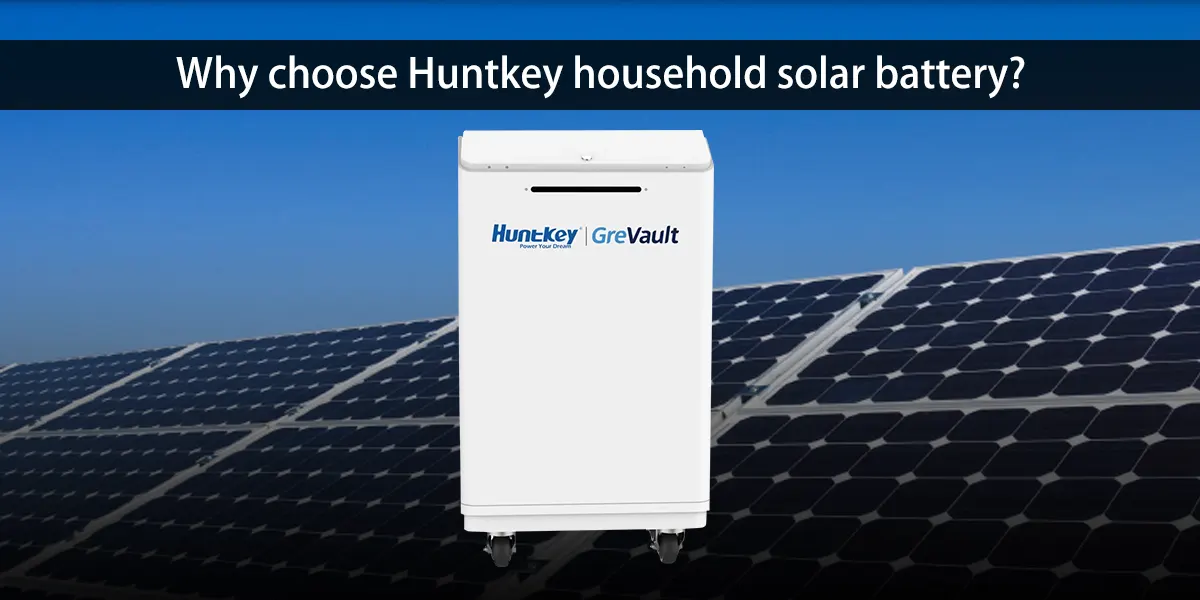
Why choose Huntkey household solar battery?
Undoubtedly, choosing a battery manufacture is a one-time decision for a long period, so this decision should be wise and accurate.
To overcome the confusion, we’ve researched a lot to recommend so as to get the best one from the Huntkey storage system. Now the question uplifts in mind why choose a Huntkey household solar battery? Here are the following facilities that Huntkey Batteries provide:
- Energy Consumption
Huntkey offers efficient and constant energy storage which ensures reliable performance of power supply to household electrical appliances. - High Compatibility
They provide batteries with high compatibility with several solar inverters that make integration with solar systems seamless. - Life Cycle
The long life cycle of Huntkey Batteries provides long-term performance and durability. - 24/7 Customer Support
In addition to providing 24/7 Support, they help their customers with maintenance and installation. - Innovative Technology
Huntkey uses innovative technology to increase battery safety and Efficiency which results in providing more energy storage.
Where is the best place to install solar batteries? And should solar batteries be indoor or outdoor?
The location to install household solar batteries must be dry, and cool with proper ventilation. Moreover, solar batteries should be installed indoors, including utility rooms and the garage. It’ll let the battery ensure efficient performance for a long time and protect it from extreme weather and temperature fluctuations. When needing to install it outdoors, It is recommended to select a household solar battery equipped with a weatherproof enclosure.
How long do household solar batteries last?
Household Solar batteries can last 10-15 years based on the usage, maintenance, and brand. Most recommended solar batteries i.e. “Lithium Ion Batteries” have a lifespan of more than ten years with a warranty. In addition, regular care with proper maintenance and monitoring can increase optimal performance and lifespan.
FAQs
If the solar system is grid-tied, the battery diverts excess solar power to the grid for net metering credits. In the case of an off-grid solar system, a charge controller can either stop energy production or redirect it to auxiliary loads, ensuring system safety and overcharging prevention.
Yes, you can charge your household solar battery from the grid overnight depending on its design. But it is not recommended to charge overnight, which is not conducive to battery safety and performance. Grid charging helps to take advantage of low electricity bills during off-peak time. Please make sure to get the battery fully charged for use during power outages or peak demand hours.
Overcharging, exposure to extreme weather conditions, deep discharging and temperature fluctuations can damage household Solar batteries. Lack of maintenance and connection can also reduce battery lifespan. Moreover, incompatible charging equipment or Inverters can also cause performance problems which results in battery damage.
Conclusion
In conclusion, for those seeking to avoid unnecessary expenses and invest in a reliable household battery, a lithium-ion option stands out for its superior reliability, optimal performance, and extended lifespan. To minimize the need for repetitive maintenance and to benefit from a solid warranty period, selecting a trustworthy brand is essential. As the top BESS manufacturer, Huntkey energy storage is recommended. This guide aims to assist in making the best choice.


+86 – 18925002618