



There are a variety of industrial and commercial energy storage terminal scenarios. From the perspective of scenarios, the groups that are currently highly motivated to invest in industrial and commercial energy storage mainly include electric vehicle charging stations, large industrial/commercial parks, and large power-consuming enterprises (polysilicon, semiconductors, etc.).
First, medium and large power-consuming entities mainly include cement, alloy, steel, coal, lime, coking and other industries, and manufacturing customers with an annual power consumption of more than 1 million KWh. Since the continuity of production has a huge impact on its operating efficiency, and its annual power consumption is large, the difference in electricity prices at different times of the day is higher than that of general industrial and commercial businesses (implementing 1.5 times the electricity purchase price), so this group is very interested in saving electricity costs and peak and valley The need for arbitrage is greater.
Second, supermarkets and office buildings mainly refer to commercial buildings and large supermarkets and malls in medium and large cities. Due to the obvious high and low peaks of electricity load in commercial buildings and fixed electricity consumption habits, the mode of using energy storage to reduce capacity electricity charges and peak-to-valley differences to save electricity costs is mature and the demand is clear. However, the space of commercial buildings is small, and industrial and commercial energy storage products The volume energy density requirement is higher.
Third, the motivation for configuring industrial and commercial storage at electric vehicle charging stations mainly comes from the popularization of fast charging functions for electric vehicles. Power battery fast charging will become a key means to solve the mileage anxiety of electric vehicles and improve the economy of use. With the mass production and mass loading of high-rate batteries, the power demand for charging stations will increase rapidly in the future.
At that time, the grid transformer will face the risk of insufficient capacity and grid collapse during the charging peak period. The large-area distribution network expansion demand derived from the charging of a large number of electric vehicles can be solved by configuring industrial and commercial energy storage.
At present, enterprises have defined power modules for different applications to match different markets. This not only tests the company’s design and understanding of batteries and systems, but also requires it to have a strong electrical and electronic technology background and software logic design capabilities.

With the rapid development of global energy transformation and renewable energy, energy storage systems are increasingly used in industrial and commercial fields. The main function of the system is to control and manage the charging and discharging process of the energy storage battery to ensure the safe operation of the battery system and the system Performance optimization.
The global energy storage market is showing a trend of rapid growth. In 2019, the global industrial and commercial energy storage market capacity increased by 50%, reaching 6.7GWh; in 2022, the global industrial and commercial energy storage market capacity reached 55.4GWh.
It is estimated that by 2025, the newly installed capacity of industrial and commercial energy storage in the world will reach 45.7GWh, and the global industrial and commercial energy storage market capacity will reach 135.5GWh.

In 2021, the newly installed capacity of industrial and commercial energy storage in the United States will reach 163MW/353MWh, a year-on-year increase of 29.06%/17.23%. In the first three quarters of 2022, the installed capacity of industrial and commercial energy storage in the United States will be 258MWh, a year-on-year increase of 16%, accounting for 2.4% of the overall installed capacity of energy storage in the United States.

In addition, Germany’s industrial and commercial installed capacity accounts for less than 5% of the total installed capacity: in 2021, industrial and commercial energy storage installed capacity will be 27MW/57MWh, accounting for 4.2%/3.4% of the total installed capacity respectively.
In 2022, the total scale of grid-connected projects in China’s energy storage market will reach 7.762GW/16.428GWh, and the power and capacity will increase by more than 220% year-on-year.
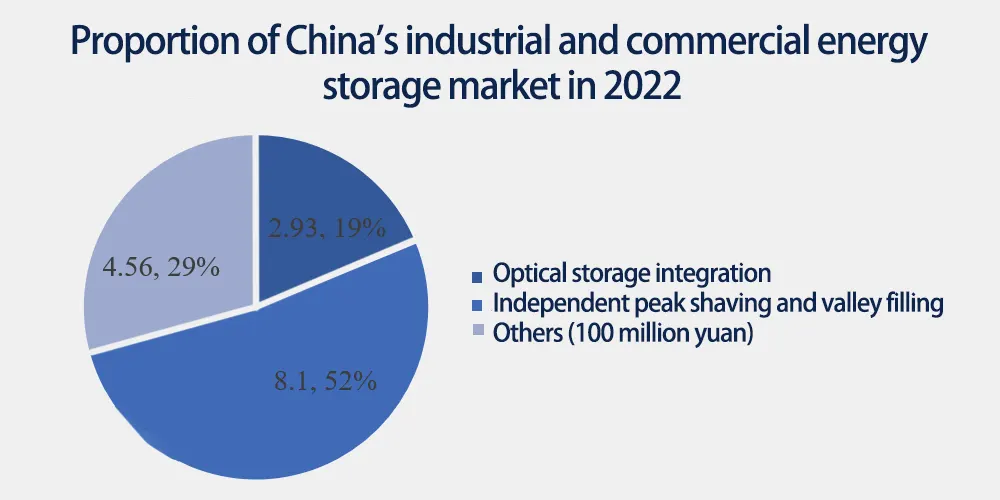
In 2022, the cumulative installed capacity of industrial and commercial energy storage in China will be 705.5MW, and the new installed capacity will be 365.2MW. The scale of the industrial and commercial energy storage market will be about 1.559 billion RMB, of which 293 million RMB will be in the field of optical storage integration, and 810 million RMB will be in the field of independent peak-shaving and valley filling. 456 million RMB in other fields.
At present, industrial and commercial storage is mainly distributed in major industrial and commercial provinces such as Jiangsu, Guangdong, and Zhejiang, and the cumulative total energy accounts for 81.67% of the total industrial and commercial energy.
China’s industrial and commercial rooftop distributed photovoltaic installed capacity market space is about 384GW, and China’s industrial and commercial energy storage installed capacity market space is about 76.8GW. There is still a lot of room for improvement in the penetration rate of the industrial and commercial energy storage market in the future.
The industrial and commercial energy storage base in the global market is small, and it is expected to grow to more than 20GWh in 2023. Considering that the IRA in the United States increased the ITC subsidy for energy storage systems from 26% to 30% and extended the period for 10 years, as well as the needs of European industrial and commercial power users to ensure the stability of power consumption, industrial and commercial energy storage still has a certain growth space in the world.
It is expected that From 2022 to 2025, the installed capacity of new industrial and commercial energy storage in the United States will reach 1.1/2.6/5.2/10.3GWh respectively, corresponding to a CAGR of 112% from 2022 to 2025.
In general, the current scale of industrial and commercial energy storage in major European and American countries is still relatively small, and there is broad room for future growth.


This article introduces the new technology of flywheel energy storage, and expounds its definition, technology, characteristics and other aspects.

What are chemical energy storage devices, how do they work, and what are the advantages of employing them? Read on to learn about chemical energy storage system.

Through the innovation and integration of energy storage technology, battery energy storage container can provide reliable and efficient energy storage and release solutions.

 +86 – 18925002618





