


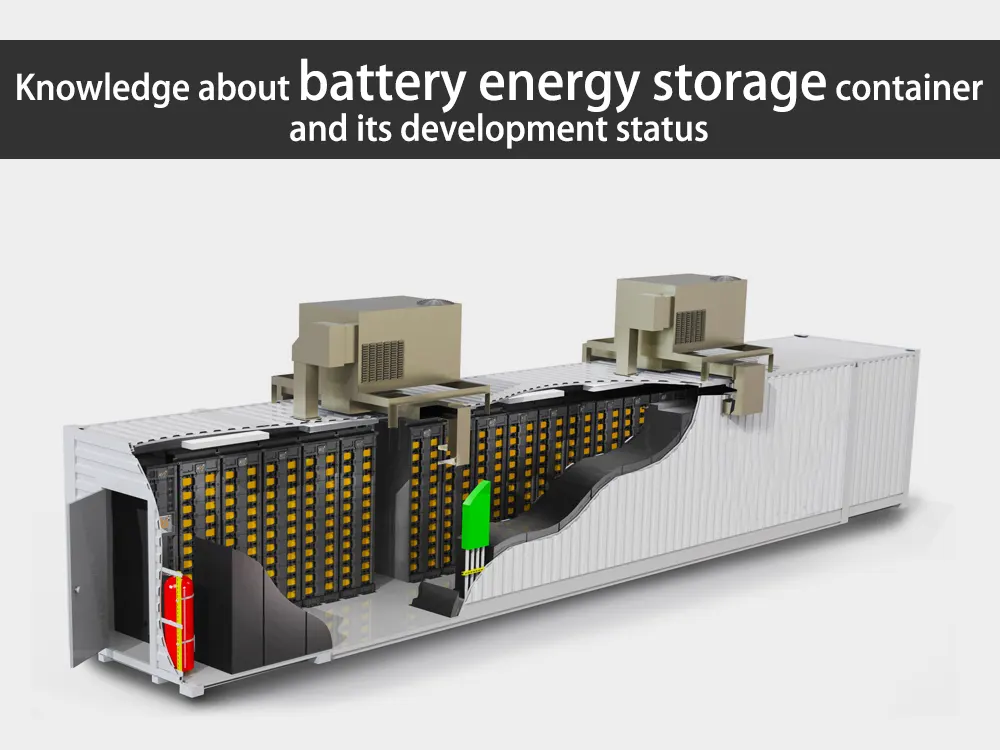


The external interface of the battery energy storage container is the interface connecting it with the external power grid, power generation equipment, load equipment, etc. Through the external interface, the energy storage container can realize two-way energy flow with the grid, realize energy storage and release, and provide stable power support for external equipment.

As an important technology in the energy field, battery energy storage container contain storage materials and components that constitute their ability to efficiently store and release energy. The following will introduce the common storage materials inside the battery energy storage container as well as their characteristics and application fields.
- Li-ion battery
Lithium-ion batteries are currently one of the most common and widely used energy storage technologies. It uses the reciprocating migration of lithium ions between the positive and negative electrodes to store and release electrical energy. Lithium-ion batteries are widely used in electric vehicles, renewable energy storage, and mobile devices due to their high energy density, long lifetime, and low self-discharge rate.
- Na-S battery
Sodium-sulfur battery is a high-temperature energy storage technology, the positive electrode material is sulfur, and the negative electrode material is metallic sodium. Sodium-sulfur batteries have the characteristics of high energy density, high efficiency and long cycle life, which are suitable for large-scale energy storage and long-term storage requirements. The application fields of sodium-sulfur batteries include power grid peak shaving and valley filling, renewable energy storage and emergency power, etc.
- Lithium titanate battery
Lithium titanate battery is a high-power energy storage technology, and its positive electrode material is lithium titanate. Compared with traditional lithium-ion batteries, lithium titanate batteries have higher charge and discharge rates and longer cycle life. Therefore, it is often used in scenarios that require frequent charging and discharging and high power output, such as electric vehicles, grid peak shaving, etc.
- Fuel cells
A fuel cell is a device that converts chemical energy directly into electrical energy. It uses hydrogen as a fuel and oxygen as an oxidant to generate electricity through an electrochemical reaction. Fuel cells feature high energy conversion efficiency, low pollution and quiet operation. It has broad application prospects in renewable energy storage, mobile devices, and aerospace.
- Supercapacitor
A supercapacitor is a device that can store and release electrical charge efficiently. It uses a charge separation mechanism between electrodes to store electrical energy. Supercapacitors have high charge and discharge rates, long cycle life, and good high temperature resistance. It is often used in fields with large transient power requirements, frequent charging and discharging, and fast response, such as frequency regulation of electric vehicles and power systems.

The fire protection system takes each battery pack as the smallest protection unit, adopts a new fire extinguishing technical solution of gas-liquid two-phase atomized fire extinguishing agent, and uses suction detectors, combustible gas detectors, and temperature-sensing smoke detectors to control the entire battery energy storage container. The box is monitored in all directions and detected from time to time.
Among them, the aspirating detector monitors and protects the entire cluster of battery boxes in units of battery clusters, the combustible gas detector monitors and protects the battery compartment, and the temperature-sensing smoke detector monitors and protects the electrical compartment.
When a thermal runaway fire occurs in a battery pack, the detector detects the fire, and the detector opens the partition control valve of the battery pack, and at the same time transmits the fire information to the fire suppression host through the CAN bus, the sound and light alarm is turned on.
The air system is turned on to suppress the main unit’s starting output, and the fire extinguishing agent is delivered to the gas-liquid two-phase nozzle through the pipeline and the partition control valve. The fire extinguishing agent is atomized through the nozzle, and then sprayed into the battery pack to implement the cooling and fire extinguishing functions.

With the rapid development of renewable energy, the global energy storage market is gradually expanding. According to data, the global battery energy storage market reached 51.1 GWh in 2019, and is expected to reach 620 GWh by 2025, with a compound annual growth rate of over 38%. This trend is also driving the global battery energy storage container market.
The global battery energy storage container market is mainly concentrated in North America, Europe, and Asia Pacific. The North American market accounts for 40% of the global market share, the European market accounts for 30%, and the Asia-Pacific market share is about 20%. The market concentration of these three regions is relatively high, mainly due to the policy support of the local government, technological innovation and mature market demand and other reasons.
Overall, the future of the battery energy storage container industry looks bright, with huge growth potential both in China and globally. As the industrial energy storage continues to mature, readers can expect to see more advanced and efficient battery energy storage system design, improved system integration and monitoring capabilities, and greater adoption of renewable energy, all of which will contribute to a more sustainable and more reliable energy future.


can a hybrid inverter work without a battery? Yes, it can operate in a grid-connected setup to supply power directly from solar energy, but without storage, it cannot provide backup power or store excess energy, making a battery a valuable upgrade for better efficiency and reliability.

Lithium batteries do not emit harmful radiation. They operate through safe chemical processes, making them reliable and widely used for modern energy storage systems

Rechargeable batteries vs regular batteries differ in efficiency, lifespan, and application. Rechargeable batteries support repeated use and continuous energy storage, making them ideal for long-term and high-demand systems, while regular batteries are limited to single-use, short-term applications.

 +86 – 18925002618





