

energy storage system

The most comprehensive guide to thermal energy storage

The most comprehensive guide to thermal energy storage
As the global energy system gradually advances towards decarbonization and clean transformation, thermal energy storage technology plays an important role in improving the flexibility of the energy system.
Table of Contents
    Add a header to begin generating the table of contents

    Thermal storage technology plays an important role in improving the flexibility of the global energy storage system, achieving stable output of renewable energy, and improving energy utilization efficiency. This article will elaborate on the concept, classification, types, use scenario technology development, energy conversion process and prospects of thermal energy storage.

    YouTube_play_button_icon_(2013–2017)

    1.What is thermal energy storage?

    Thermal energy storage technology (TES) temporarily stores energy (solar heat, geothermal, industrial waste heat, low-grade waste heat, etc.) by heating or cooling the energy storage medium so that the stored energy can be used for power generation, heating and Cooling.

    For example, liquids or solids are used to store excess electrical and thermal energy. The stored heat is then used to provide thermal energy for the generator to generate electricity.

    2. Types of thermal energy storage technologies

    According to different heat storage principles, heat storage technology (TES) can be divided into sensible heat storage, phase change heat storage and thermochemical heat storage.

    1. Sensible heat storage (SHS): Stores (or releases) heat by increasing (lowering) the temperature of solid or liquid materials without any phase change.
    2. Latent heat storage (LHS): Heat is stored in a certain medium (or released from the medium), and the medium experiences changes in physical state during the process of storing and releasing heat.
    3. Thermal chemical heat storage (TCHS): Heat is stored and released through endothermic or exothermic chemical reactions between two components.

    These three types of thermal storage systems cover a wide range of operating temperatures (generally applied in the temperature range of -40°C to 700°C), and a wide range of energy storage (generally applied in 10-2250MJ/m3).

    Thermal storage technology (TES) can be divided into sensible heat storage, phase change heat storage and thermochemical heat storage

    3. Advantages, disadvantages and application scenarios of thermal energy storage technology

    Compared with other forms of technology, thermal storage technology has unique advantages:

    1. Demand transfer. Reduce peak and level demand by storing energy when demand is low and releasing energy when demand is high;
    2. Volatility energy supply integration. Reducing CO2 emissions and lowering costs by ensuring energy is used when it is cheaper and there is more renewable energy in the mix;
    3. Department integration. Improve the overall energy efficiency of energy systems, where off-peak power is used to drive heat pumps that can generate heat generated from cheaper electricity and waste heat from industrial sources to balance energy system loads;
    4. Power grid management. Through deployment, the pressure on the power grid can be relieved and the need for expensive power grid upgrades can be reduced;
    5. Seasonal energy storage. Heat is stored in the summer to meet the heating demand in the winter, while cold energy is stored in the winter to meet the heating demand in the summer.

    At the same time, the obstacles faced by its deployment cannot be ignored:

    1. The application scenarios are relatively limited;
    2. Technology and systems are relatively immature;
    3. The efficiency of the thermoelectric conversion step is one of its limiting factors.

    The efficiency of the thermoelectric conversion step is one of the limiting factors for thermal energy storage

    4. Energy conversion process of thermal energy storage

    Thermal Storage Technology (TES) uses electricity to heat and insulate materials, and finally converts the heat back into electricity through a power conversion device.

    The three main steps of thermoelectric conversion are converting electrical energy into thermal energy, storing thermal energy, and converting thermal energy back into electrical energy.

    Typical energy losses associated with each step in a universal thermal storage technology system with a round trip efficiency of 47% (the ratio of power delivered back to the grid to power extracted from the grid).

    5.How do thermal energy storage systems work?

    The fluid is stored in two tanks—one at high temperature and the other at low temperature. Fluid from the low-temperature tank flows through the solar collector or receiver, where solar energy heats it to a high temperature, and it then flows to the high-temperature tank for storage.

    6.How is thermal energy stored?

    Thermal energy storage means heating or cooling a medium to use the energy when needed later. In its simplest form, this could mean using a water tank for heat storage, where the water is heated at times when there is a lot of energy, and the energy is then stored in the water for use when energy is less plentiful.

    7. What is the current technological status of thermal energy storage?

    Thermal storage technology includes two elements. One is the conversion of thermal energy, which includes not only the conversion between thermal energy and other forms of energy, but also the transfer of thermal energy between different material carriers; the second is the storage of thermal energy.

    That is, the existence state of thermal energy on the material carrier, which is theoretically expressed as its thermodynamic characteristics. Although there are many forms of heat storage, such as sensible heat storage, latent heat storage and chemical reaction heat storage, they are essentially the energy of the thermal movement of a large number of molecules in a substance.

    Therefore, in a general sense, the thermodynamic properties of thermal energy storage are the same as those of thermodynamics, and both have two measurement characteristics: quality, that is, the first law and the second law of thermodynamics.
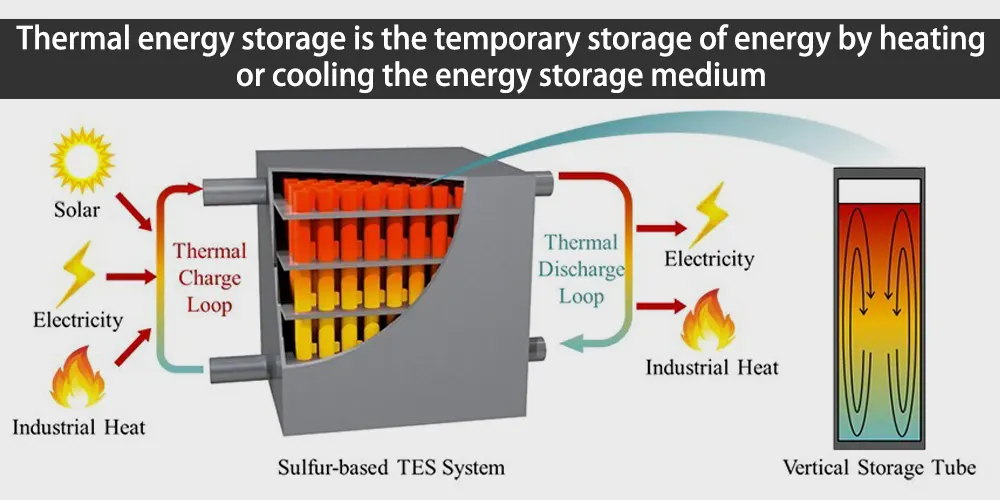
    Thermal energy storage is the temporary storage of energy by heating or cooling the energy storage medium

    8. Technical direction of thermal energy storage materials

    Research on heat storage materials is currently focused on sensible heat storage materials and phase change materials, especially high-temperature phase change materials with high heat storage density and compact heat storage device structures.

    Among them, various mixed salts can be used in Controlling the melting temperature of substances by adjusting the ratio of different salts in the medium-high temperature working area has attracted the interest of many researchers.

    The temperature of sensible heat storage materials cannot remain stable during the energy release process, and the heat loss during heat exchange is high. It cannot store heat for a long time, and its heat storage capacity is low, which cannot meet today’s industrial requirements;

    Chemical heat storage uses the reversible

    Thermal energy storage is a type of chemical energy storage, endothermic/exothermic reaction process of heat storage materials to store and release heat. Although this method has better heat storage capacity and relatively small heat loss, it faces corrosion of equipment by heat storage materials and heat transfer. Problems such as poor mass transfer capacity and difficulty in material development limit practical applications;

    Latent heat storage technology uses phase change materials to absorb or release heat during the phase change process, thereby performing heat exchange, which makes up for the shortcomings of sensible heat storage that cannot preserve heat for a long time. Moreover, the energy storage density is large, and no chemical reaction occurs. Cause harm to the ecological environment.

    9. The Prospects of thermal energy storage

    From the perspective of global development trends, the development of heat storage technology is a need for long-term international heat storage technology competition, and it is also a requirement to achieve the carbon neutrality target of 3060 carbon peak.

    Secondly, thermal energy accounts for more than 50% of terminal energy consumption demand, which means that the value and development space of thermal storage is no smaller than that of electricity storage. Therefore, the development of long-term thermal energy storage is necessary.

    That’s all about thermal energy storage, if you are interested in energy storage, you can refer to Top 10 energy storage battery manufacturers in the world.

    The global cumulative installed capacity of long-duration energy storage will reach 1.5-2.5TW

    Related posts

    logo+86 – 18925002618
    [email protected]
    Guangpu West Road, Huangpu, Guangzhou, Guangdong, China

    Product

    Video Gallery

    Huntkey automated battery storage workshop process
    Huntkey Grevault participated in Germany ESE exihition with 5KW mobile power bank
    Contact Form Demo
    Scroll to Top




