Why are lead-acid batteries still standing in the market after more than a hundred years? Why is it that today, the installation rate of lead-acid batteries for electric bicycles is still over 80%? This article will take you to explore acid for lead acid battery.
1. Lead-acid battery
The lead-acid battery was invented by French physicist Gaston Plante in 1859 and was the first rechargeable battery for commercial use. The historic lead-acid battery is still widely used today.
Its popularity is easy to understand: Lead-acid is reliable and inexpensive per watt-hour, and few other batteries offer the same amount of cheap recyclable power that makes lead-acid batteries widely used in automobiles, Golf carts, forklifts, ships and ups energy storage.
2. Composition of lead-acid battery
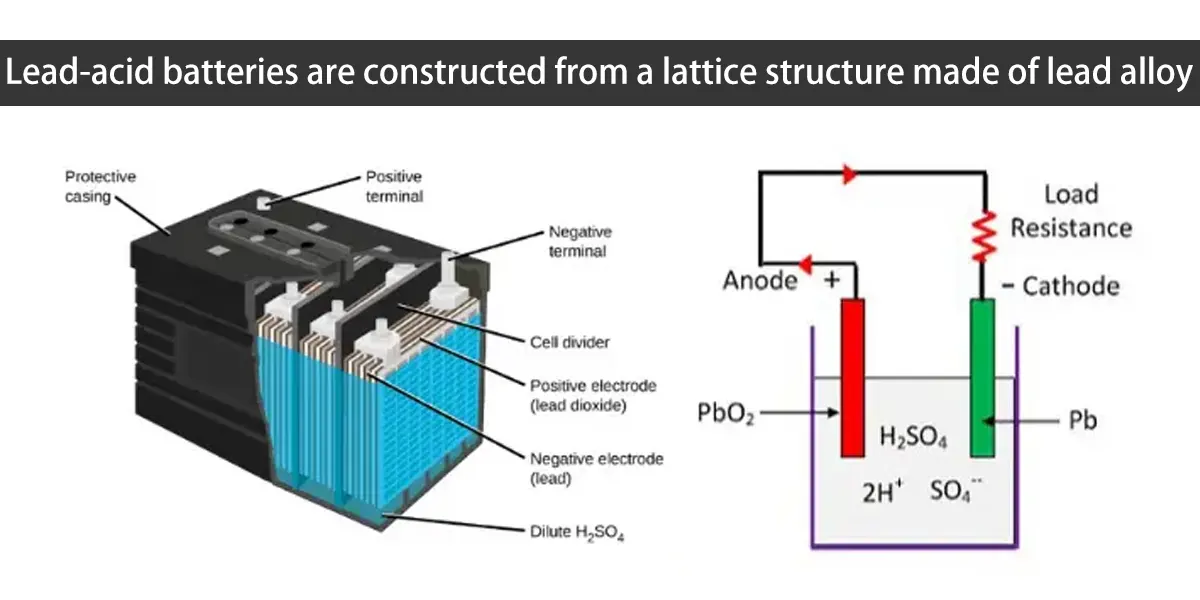
Lead-acid batteries are constructed from a grid structure made of lead alloy. Because pure lead is too soft to support itself, small amounts of other metals such as antimony, calcium, tin, and selenium are added to help it gain greater mechanical strength while improving its electrical properties. These batteries are often called “lead” batteries. – Antimony” and “Lead-Calcium” batteries.
Adding antimony and tin to lead-antimony and lead-tin batteries can improve deep cycling, but doing so increases water consumption and increases neutralization requirements.
Although calcium can reduce self-discharge, when the lead-calcium plate of the positive electrode is overcharged, there will be side effects due to grid oxidation. Therefore, modern acid for lead acid battery also uses other dopants such as selenium, cadmium, tin and arsenic to reduce the content of antimony and calcium to reduce the impact of side effects.
3.Acid for lead acid battery
Lead-acid has a higher specific gravity, but is not as durable as nickel- and lithium-based systems when cycled deeply. Because fully discharging a lead-acid battery causes strain, the battery permanently loses a small amount of capacity with each discharge/charge cycle. When the battery is in good working order, this loss is minimal, but once performance drops to half its rated capacity, the decay accelerates. This wear characteristic applies to all batteries to varying degrees. Here’s more information about Lead acid battery vs lithium ion.
4. Different types of Acid for lead acid battery
Lead acid for deep cycle applications can provide 200 to 300 discharge/charge cycles depending on the depth of discharge. The main reasons for its relatively short cycle life are mesh corrosion on the positive electrode, depletion of active material and expansion of the positive plate; aging phenomena are accelerated when the operating temperature increases and high discharge currents are drawn.
Charging battery of this type is easy, just follow the correct voltage limits. Choosing a low voltage limit will protect the battery better, but will result in poor performance and lead to sulfide build-up on the negative plate. Limiting at high voltage will improve battery performance but will create grid corrosion on the positive plate. Sulfation can be reversed with timely repairs, but corrosion on the positive electrode will be permanent.
5. Characteristics of Acid for lead acid battery
Lead-acid is not suitable for fast charging, with a full charge taking 14-16 hours for most battery types. Batteries must always be stored in a fully charged state. Low battery capacity can cause sulfation of the battery and reduce battery performance. Adding carbon to the negative electrode can reduce this problem, but will reduce the battery’s specific energy.
Lead-acid has a moderate lifespan, is not as affected by battery cycling as nickel-based systems, and has the best charge retention among rechargeable batteries. Nickel cadmium loses about 40% of its stored energy within three months, while acid for lead acid battery maintains the same energy within a year.
At the same time, lead-acid batteries work well under low temperature conditions, and acid for lead acid batteries are superior to lithium-ion batteries when working under sub-zero conditions. According to RWTH Aachen University in Germany (2018), the cost of liquid-immersed lead-acid is approximately US$150 per kWh, which is one of the lowest cost levels among batteries.
6. Sealed lead-acid battery
The original sealed lead-acid batteries appeared in the mid-1970s, although engineers believed that the term “sealed lead-acid” was a misnomer because no lead-acid battery could be completely sealed: In order to control gassing during intense charging and rapid discharging, valves are added to sealed batteries so that when pressure rises, gasses will be released.
In addition, the electrolyte of a sealed battery is not soaked in a liquid, but in a humidified separator. Similar to the design of nickel and lithium-based systems, the sealed battery can operate normally in any physical direction without acid for lead acid. The battery does not leak.
7. Gel battery
VRLA is also called a gel battery because it contains a silica-type gel with an electrolyte suspended in a slurry. If gas builds up and rises, VRLA’s valve will act as a vent to ensure battery safety. But we should try to avoid repeated venting, as this will eventually lead to the drying up of battery capacity.
Due to its low price, reliable service and low maintenance costs, SLA remains the first choice for healthcare in hospitals and nursing homes. Larger VRLAs are used as backup power for cellular relay towers, internet centers, banks, hospitals, airports, and more.
8. Deep cycle batteries
Deep cycle batteries like lithium deep cycle battery are designed to provide continuous power for wheelchairs, golf carts, forklifts, etc. It wants to achieve the highest capacity possible and a moderately high cycle count. This is achieved by making the lead plate thicker (see picture below).
Although batteries are designed for cycling, a full discharge can still cause stress on the battery, and the number of cycles is related to the depth of discharge (DoD).
The performance of deep cycle batteries is expressed in Ah or minutes of run time, and has nothing to do with acid for lead acid batteries. Capacity is usually rated based on 5 hours and 20 hours of discharge. If you are interested, here is more about bess manufacturing company.Â


+86 – 18925002618