


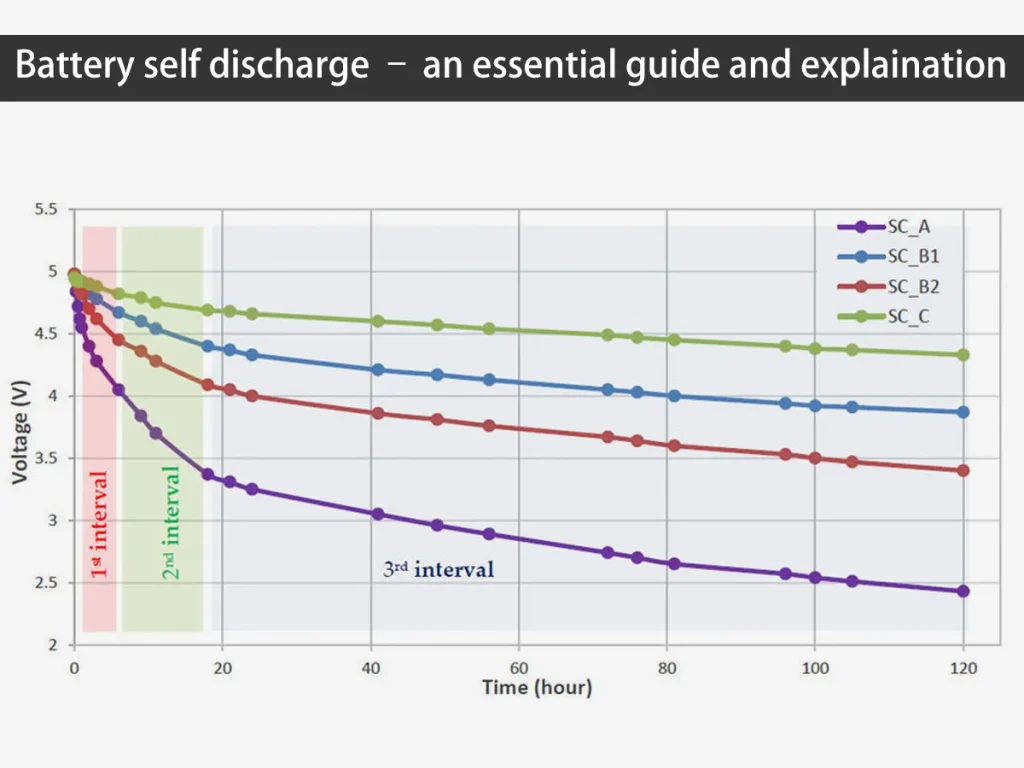


1. Self-discharge leads to a decrease in capacity during storage.
Several typical problems caused by excessive self-discharge:
a. The car has been parked for too long and cannot be started;
b. The voltage of the battery is normal before it is put into storage, but low voltage or even zero voltage is found when it is shipped;
c. When the car GPS is placed in the car in the summer, after a period of use, it feels that the power or usage time is obviously insufficient, and the battery may even become swollen.
2. The self-discharge of metal impurities causes the aperture of the separator to be blocked, or even pierces the separator to cause a local short circuit, endangering the safety of the battery.
3. Self-discharge causes the SOC difference between batteries to increase and the battery pack capacity to decrease.
Due to the inconsistent self-discharge of the battery, the SOC of the batteries in the battery pack will differ after storage, and the battery performance will decrease. Customers often find performance degradation after receiving a battery pack that has been stored for a period of time. When the SOC difference reaches about 20%, only 60% to 70% of the capacity of the combined battery remains.
4. A large difference in SOC can easily lead to overcharge and overdischarge of the battery.
1. Self-discharge detection method
1) Voltage drop method
The rate of voltage decrease during storage is used to characterize the magnitude of self-discharge. This method is simple to operate, but the disadvantage is that the voltage drop does not intuitively reflect the loss of capacity. The voltage drop method is the simplest and most practical, and is the method commonly used in current production.
2) Capacity attenuation method
That is, expressed as the percentage of capacity reduction per unit time.
3) Self-discharge current method Isd
Calculate the self-discharge current Isd during battery storage based on the relationship between capacity loss and time.
4) Calculation method for the number of moles of Li+ consumed by side reactions
Based on the fact that the Li+ consumption rate during battery storage is affected by the electronic conductance of the negative SEI film, the relationship between Li+ consumption and storage time is deduced.
2. Key points of self-discharge measurement system
The key influencing factors of self-discharge measurement: SOC; starting time; storage temperature; storage time; voltage measurement temperature; voltmeter accuracy.
1) Select the appropriate SOC
dOCV/dT is affected by SOC, and the impact of temperature on OCV is significantly amplified at the platform, resulting in large SOC prediction errors. It is necessary to choose a SOC that is relatively insensitive to temperature changes to test self-discharge, such as: FC1865: 25% SOC to test self-discharge; LC1865: 50% SOC to test self-discharge.
Due to differences in battery capacity, the SOC of the actual battery fluctuates, and the tolerance is about 4%. Therefore, the change in the slope of the OCV curve within the tolerance range of 5% is examined. LC1865 has very stable slopes at 53% and 99.9% SOC, which are 3.8mV/%SOC and 10mV/%SOC respectively. The slope at FC1865~25%SOC is relatively stable; of course, the full charge state is also a simple and practical self-discharge measurement point.
2) Selection of starting time
FC1865 Under 25% SOC (or other SOC values), look at the hourly voltage changes after charging. After 20 hours, the voltage drop rate is basically the same. It can be considered that the polarization has basically recovered. Therefore, 24h is selected as the starting time of the self-discharge test.
After 14 hours under 50% SOC, the voltage change rate of LC1865 fluctuates in a small range around 0.01mV/h. It can be considered that the polarization has basically recovered, and it is feasible to select 24 hours as the starting point of self-discharge.
3) Storage temperature and time
Effect of storage temperature and time on self-discharge (LC1865H)
Within the study interval, self-discharge has a significant linear relationship with time and temperature. The self-discharge model can be fitted as: self-discharge=0.23*t+0.39*(T-25). (The above values and relationships are related to the battery system, and the constants will change accordingly, as will the other relationships below.)
Due to the decrease in chemical reaction rate at room temperature, the abnormal points of physical self-discharge are more obvious. 14D storage can predict 28D results very well.
Battery self-discharge will reduce product quality and reduce customer satisfaction. So how to deal with battery self-discharge? This can be done from the following aspects:
1. Strictly control the introduction of dust
The most common cause of battery low voltage is dust and burrs. How to control the introduction of dust is a very important and difficult task. The management of many manufacturers attaches great importance to the control of workshop dust, but it is often ignored at the practical level.
On the one hand, the factory building design must be reasonable. In the area where the pole piece manufacturing process is located, dust control is not particularly strict, especially in the slurry preparation area. However, during the lithium battery assembly process, dust impurities must be strictly prevented from entering. In the design of the factory building, different areas must be strictly separated and isolated and protected.
The second is to do a good job in 5S work in the operating area. Having good habits and high 5S literacy can improve the product yield rate. For example, clean up before work to ensure that there is no dust, clean the equipment after operation to ensure that no impurities remain, etc.
2. Improve the pole piece manufacturing process
Burrs are also the culprit of self-discharge in lithium batteries. Burrs are mainly formed during pole piece slitting. There are many reasons for the formation of burrs:
(1) The raw battery materials of the positive and negative electrode slurries are made of materials with larger BET, and a lot of conductive agent is added, which causes the active material, conductive agent and other particles to be weakly bonded and burrs appear. Then it is necessary to choose appropriate materials and improve slurry preparation, coating and other processes to ensure that the pole pieces will not lose powder or produce burrs.
(2) The slicing tool is not replaced in time, causing burrs. Be familiar with the life of the cutter and replace it in time according to usage.
3. Raw material quality management and control
As mentioned above, metal impurities in positive and negative electrode materials are also one of the reasons for self-discharge of lithium batteries. Therefore, the company needs to strengthen the inspection of incoming materials to ensure that the incoming materials meet the standards, otherwise it will cause great losses. At the same time, we must also strengthen the quality control of raw materials to prevent failure caused by the introduction of impurities and moisture during storage.
4. Environmental control
In terms of environmental control, it is not only necessary to control the number of dust particles in the environment, but also to control the moisture content in key steps to prevent excessive moisture content from adversely affecting the quality of lithium batteries.



 +86 – 18925002618





