



Owner self-investment model, that is, the owners of industrial and commercial enterprises invest and benefit themselves, and the main profit channel is peak-valley arbitrage.
Take an industrial and commercial enterprise in Zhejiang Province as an example. The enterprise invested in a 1MW/2MWh user-side energy storage project. The stable load of the factory during the day can completely absorb the energy storage and discharge, and the capacity of the transformer can meet the demand for energy storage and charging.
At present, the peak electricity price period of the agency electricity purchase price in Zhejiang Province is 9:00-11:00 and 15:00-17:00. The trough hours are 11:00-13:00 and 22:00-8:00 the next day.
According to this division, the industrial and commercial energy storage power stations in Zhejiang Province can adopt the “low-sharp” and “low-high” revenue model that cooperates with each other in a single day to maximize revenue.
Taking the 1-10kv large-scale industrial power consumption in Zhejiang Province in August 2023 as an example, the peak electricity price is 1.2609RMB/kWh, the peak electricity price: 1.0732RMB/kWh, and the low valley electricity price: 0.3167RMB/kWh.
Others: According to the winning bids of 22 energy storage EPC projects in June, the unit price range of 2h system EPC projects is 1.376-2.226RMB/Wh. We take the average winning bid price of 1.64RMB/Wh to calculate the cost.
It is also calculated based on 90% discharge depth, 5% system efficiency decay in the first year, 2% per year thereafter, 92% charge and discharge efficiency, and 330 days of consumption.
According to the above background setting, the enterprise’s 1MW/2MWh industrial and commercial energy storage power station arbitrages through peak-valley price difference.
Annual income = discharge income – charging cost = actual discharge amount * peak electricity price – actual full required electricity * valley electricity price
Substituting the data into the calculation, the peak-valley arbitrage income of the energy storage project in the first 8 years = 6265394.23RMB
Investment cost=1.64RMB/Wh*2000000Wh=3280000RMB;
Payback period = total cost/(peak and valley arbitrage income in the first 8 years/8)=3280000/(6265394.23/8)≈4.2 (years)
This example is a very typical implementation of owner-operated industrial and commercial energy storage systems. Under the self-investment mode of the owner, the payback period of the energy storage project is the fastest.
Some industrial and commercial enterprises want to invest in energy storage power stations by themselves, but are limited by insufficient funds. In this case, financial leasing companies can be introduced as lessors of energy storage equipment to reduce financial pressure.
During the lease period, the ownership of the energy storage equipment belongs to the financial leasing party and the owner has the right to use it. After the lease expires, the owner can obtain the ownership of the energy storage equipment.
The financial leasing of user-side energy storage mainly includes two modes: direct lease and leaseback. Under normal circumstances, direct lease financing is applicable to new projects, and sale-and-leaseback financing is applicable to acquired projects.

In the direct lease model, the interest paid by the lessee can generally enjoy the tax policy dividend of 13% value-added tax deduction.
Normally, the financing amount for user-side energy storage is 70%-80% of the total investment. Under this ratio, the cash flow of the project can better cover the rent.
The financing period of user-side energy storage is generally not higher than 6 years, and cannot exceed the service life that can be satisfied by the number of battery cycles under the charging and discharging strategy of the project.
Industrial and commercial enterprises deploy energy storage, either because they consume a lot of electricity and have a rigid demand to cut peaks and fill valleys to reduce electricity bills. Either there is a demand for arbitrage by using the difference in peak and valley electricity prices.
Regardless of the type, the higher the peak-to-valley electricity price difference in the area where the company is located, the greater the value of configuring energy storage.
In terms of economic benefits, it is assumed that the peak-to-valley price difference in a certain place is 0.7RMB/kWh. The installed capacity of an industrial and commercial energy storage project is 10MW, and the unit investment of the energy storage system is 2 RMB/Wh.
When used by enterprises, the energy storage system can be fully charged and discharged. The battery is charged and discharged twice a day, the storage time is 2 hours, and the operation cycle is 10 years. Then its IRR is about 11.8%, and it is estimated that the investment can be recovered in 5.6 years.
And when the peak-to-valley price difference is 1RMB/kWh, under the same conditions, the IRR of the industrial and commercial energy storage project can exceed 23.0%. At this time, the profitability of the project has been significantly improved, and it is estimated that the cost can be recovered in 3.7 years.
What are the site requirements for installing an energy storage power station?
(1) The site is located outdoors, and there are no hazardous chemical warehouses within 20 meters.
(2) As close as possible to the power distribution room, the farthest distance from the power distribution room should not exceed 100 meters.
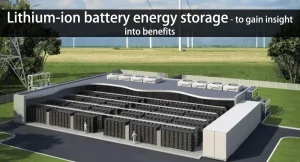
Secondly, enterprises need to consider whether there is enough area to place energy storage power stations. At present, the actual area of a 1MWh energy storage power station is only about 10㎡.
However, the distance between the front, rear, left, and right sides and the building, as well as the safety distance required by fire protection should be considered. In this way, a 1MWh energy storage power station covers an area of 20-30 square meters, and a 2MWh to 6MWh energy storage power station covers an area of about 40 to 100 square meters.


 +86 – 18925002618





