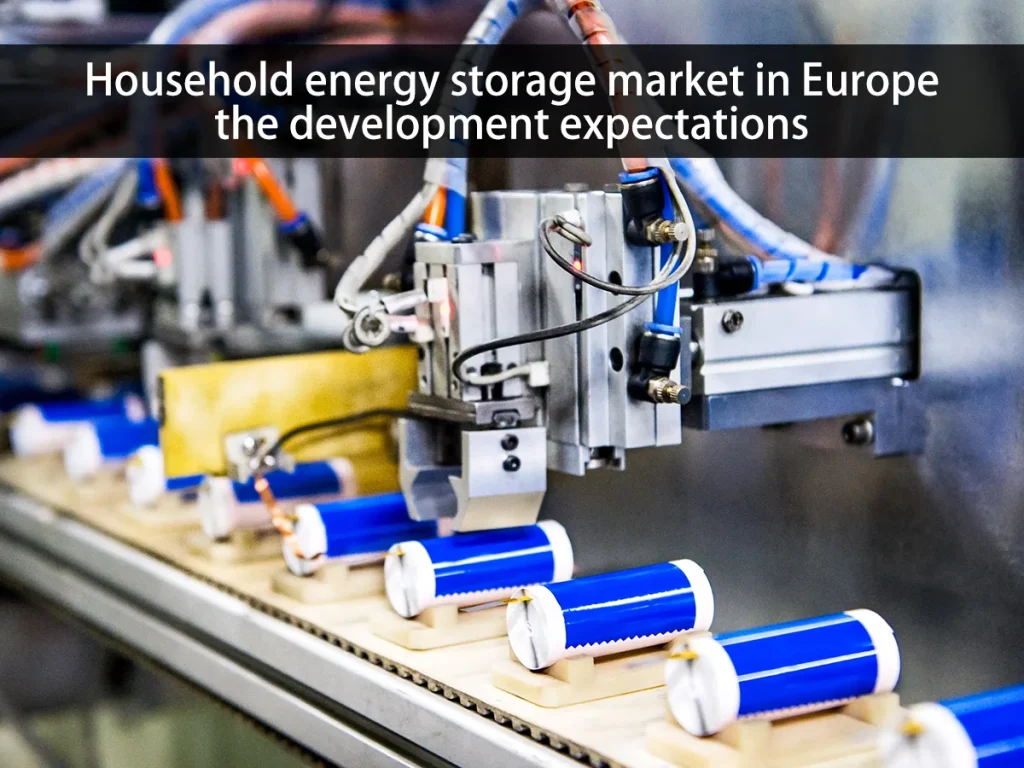
energy storage system

Household energy storage market in Europe – the development expectations

Household energy storage market in Europe - the development expectations
This article will introduce the current state of the European energy storage market and its future development expectations.
Table of Contents
    Add a header to begin generating the table of contents
    YouTube_play_button_icon_(2013–2017)

    In recent years, the European market has been affected by rising energy prices, and residential electricity prices have soared, reflecting the economy of energy storage. Driven by the anxiety of the energy crisis, various regions in Europe have introduced policies to develop clean energy and accelerate the pace of energy transformation to ensure energy supply, and the demand for household energy storage continues to grow.

    This article will introduce the current state of the European household energy storage market and its future development expectations. You can also check the following top articles in our website to know more information, such as:

    Top 10 household energy storage company in USA

    Top 10 household energy storage companies in Germany

    Top 10 household energy storage manufacturers in Europe

    The growth rate slowed down, but remained high

    With the impact of falling electricity prices, rising interest rates and policy changes, the golden age of household energy storage seems to have shrunk. Although household energy storage still has some penetration opportunities, its growth rate has slowed quietly.

    The growth rate slowed down, but remained high

    In 2023, European household storage still maintained a high prosperity, and the annual installed capacity was about 9.5GWh, an increase of about 60%, which is four times the installed capacity in 2021.

    The police Adjustment of household energy storage market in Europe

    As the main energy storage construction country in Europe, Germany’s support for household energy storage originated earlier and adopted a number of policy combinations such as financing, taxation and subsidies. For example, some policies in Germany include exempting household photovoltaic energy storage systems from income tax and providing financial subsidies for integrated optical storage and charging systems.

    Italy's policy is volatile

    The freezing of the Superbonus programme after the new Italian government came to power is the biggest factor disrupting European demand in 2023. Italy’s household energy storage policy is an important variable in 2023. In 2018, Italy issued a 50% tax credit. In 2020, the Superbonus scheme was introduced by the previous government, with tax credits increased to 110% and extended in 2021 and 2022. At the end of 2022, Italy clarified the tax credit rebate slope to 90% for projects started after 2023.

    At present, however, policy expectations are stabilised and partially covered, which is expected to support demand over the past two years. In the medium term, the household net metering model is expected to be difficult to maintain with the increase in the proportion of renewable energy, and given that Superbonus will continue to decline in 2024 and 2025, new residential demand is also expected to be stimulated.

    Additional policy changes of other countries

    In addition to Italy’s policy decline, we should also see the positive policy increase in other countries, first, purchase subsidies or tax credits, including the United Kingdom, Austria, Spain, South Africa, Greece, Hungary; The second is the adjustment of measurement methods, including California, Poland, Australia.

    Purchase subsidies or tax credits

    Since 2023, Germany has exempted all households from all value-added tax when purchasing, importing and installing light storage systems.

    In the United Kingdom, since February 2024, household energy storage can independently receive VAT relief.

    Austria has continuous subsidies for household storage, released the second round of budget in 2022, and will promote the third and fourth rounds in the future, while the VAT on photovoltaic systems will be cancelled from 2024, which is expected to indirectly drive the demand for energy storage.

    Spain has introduced incentives for renewable energy storage since June 2021, expanding the scope and increasing the budget in May 2022.

    Purchase subsidies or tax credits

    Greece announced a huge incentive plan for photovoltaic and energy storage in April 2023, which will be a positive stimulus for the market if it is successful.

    Hungary plans to provide up to 5 million forints of support for households applying for the installation of light storage systems from 2024, and the current amount of £75 billion has been applied for, which will support household storage facilities in 2024.

    South Africa also announced a tax credit policy for solar photovoltaic panels in February 2023, although it does not directly subsidize energy storage, in South Africa’s electricity conditions, photovoltaic growth will also drive energy storage demand.

    The adjustment of measurement methods

    The “net metering” method of household photovoltaic Internet makes household storage lose its economy, but with the increase in the proportion of renewable energy generation, the “net metering” to the “two-way settlement” mode is the trend.

    The adjustment of measurement methods

    Poland plans to adjust the metering method of household photovoltaic in 2024, and California in the United States began implementing NEM 3.0 in April 2023, which is the same idea.

    Australia has proposed a draft of household photovoltaic Internet access tax, which is expected to be implemented in 2024-2025.

    Forecast of global household energy storage development in 2024

    Looking ahead to 2024, the subcategories of new energy storage facilities worldwide will show the following trends:

    — Industrial and commercial energy storage (93%/112%) > Large energy storage (39%/43%) > Household energy storage (4%/11%)

    From an incremental point of view, the increase in installed global new energy storage capacity in 2024 will show the following trend:

    Large storage (53GW/130GWh) > Household storage (10GW/20GWh) > Industrial and commercial storage (7GW/18GWh)

    Development expectations for the European household storage market

    According to the statistics of EESA (European Energy Storage Association), the demand for 2023H1 European household energy storage market increased by about 5.1GWh, Q2 has basically digested the inventory at the end of 2022 (5.2GWh), and the remaining inventory is about 6.4GWh, about 8 months of installed capacity in the European household energy storage market.

    Development expectations for the European household storage market

    The European energy storage market is mainly driven by energy self-control requirements and a high economy, and it is expected that the installed capacity of European households will be 12.3GWh in 2024, an increase of 30%. In 2025, the installed capacity is 17.2GWh, and the compound growth rate from 2023 to 2025 is more than 35%, and the penetration rate of European household storage still has some room for improvement.

    Conclusion

    At present, the rate of return on European household storage is still high, compared with the previous two years, the current energy storage products are more diversified, the cost of various raw materials such as batteries is gradually declining, and the demand is also growing, and it is expected that the follow-up European household storage still has a high growth momentum.

    Related posts

    logo+86 – 18925002618
    [email protected]
    Guangpu West Road, Huangpu, Guangzhou, Guangdong, China

    Product

    Video Gallery

    Huntkey automated battery storage workshop process
    Huntkey Grevault participated in Germany ESE exihition with 5KW mobile power bank
    Contact Form Demo
    Scroll to Top