



The United States is the world’s largest and fastest-growing energy storage market.
According to statistics, the newly installed capacity of electrochemical energy storage in the United States will reach 4.80GW/12.2GWh in 2022, a year-on-year increase of 37%/16%, with new power and capacity reaching new highs.

In 2023Q1, the newly installed capacity of electrochemical energy storage in the United States reached 0.78GW/2.15GWh, a year-on-year decrease of 19%/25%, mainly due to the delay of installed capacity and grid connection projects.
In terms of installed capacity characteristics, industrial and commercial energy storage and household energy storage have few restrictions on grid connection, and the project progress is normal, with both expansion in 2023Q1.
With the implementation of IRA and ITC policies, U.S. states have introduced energy storage installation targets and energy storage subsidy plans, promoting the comprehensive development of the U.S. photovoltaic distribution and storage, independent energy storage and household storage markets.
The IRA bill stimulates the rapid development of energy storage projects – the scope of subsidies is expanded:
① In addition to photovoltaic distribution and storage, both independent large-scale storage and household storage can enjoy tax credits. In addition, the basic credit ratio is increased to 30%.

② The subsidy time is extended: ITC tax The credit is extended to 2033; the storage time requirement: more than 4 hours of storage is strictly needed.
The energy storage installed capacity in the United States is mainly distributed in areas with large photovoltaic installations, and California, Florida, and Texas, which are short of power, are at the top. California and Texas are the main markets for electrochemical energy storage in the United States.
California occupies the highest market share in the United States in the field of energy storage due to the Self-Generation Incentive Program (SGIP).
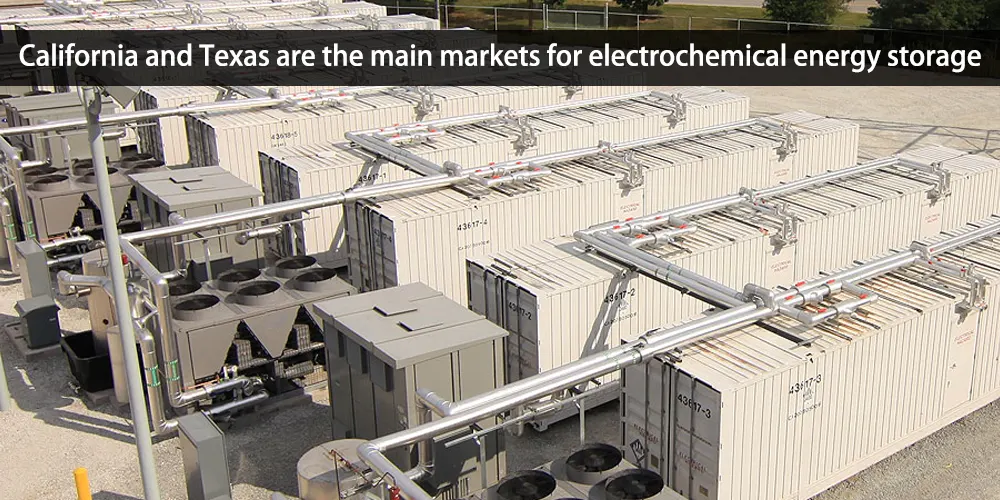
California launched SGIP in 2001 to encourage user-side distributed power generation, including wind power, fuel cells, internal combustion engines, photovoltaic energy storage and other technology types. Since 2011, energy storage has been included in the scope of support of SGIP.
Texas ERCOT is a relatively independent regional power grid in North America. Texas has many large-scale photovoltaic power stations and wind farms, which requires more reliable adjustable energy storage resources to enter the power system.
In 2022-23, Texas’ electric power load hit record highs many times in a row. Therefore, energy storage development has formed a consensus in Texas, and many energy storage projects under construction will be completed in the next few years.
Under segmented scenarios, energy storage is divided into three markets: large storage, industrial and commercial, and household storage. Industrial and commercial energy storage and household storage have large profit margins and more diverse profit models; The profit level of large reserves is low, but the scale is large.
Household energy storage in the United States started later than Europe, but population, economy, and living conditions determine that its market space is much larger than that in Europe. American residents have stronger spending power and prefer brands rather than cost-effectiveness.

In the U.S. terminal market, there are already many brands, especially in the household energy storage field, which has already formed a relatively stable pattern. Tesla accounts for more than 50%, followed by South Korea’s LG Chem, accounting for about 20%. This was followed by Enphase solaredge, SMA, Generac, Panasonic and others.
Because the market space is large enough, the large storage market leaves more room for Chinese system integrators. Among the top 10 energy storage battery manufacturers in the world, BYD’s energy storage system has been implemented on a large scale in North America, with shipments exceeding GWh in 2022.
However, a large number of energy storage system integrators with world-class influence have grown up in the United States, such as Flunence, NextEra Energy, FlexGen, Powin, etc.



 +86 – 18925002618





