



A battery tester is a device used to measure the voltage, capacity, and overall health of a battery. It typically consists of a housing with a display screen, terminals or connectors to attach the battery, and internal circuitry to measure various parameters.
Battery testers come in various forms, ranging from simple handheld devices to more advanced models with digital displays and additional features. They are commonly used in automotive maintenance, electronics repair, and other applications where batteries are utilized.
By connecting the battery to the tester, users can quickly assess its condition and determine whether it needs to be charged, replaced, or serviced. Some battery testers can also provide information about the internal resistance of the battery, its state of charge, and its overall performance characteristics. This information is valuable for ensuring reliable operation and maximizing the lifespan of batteries in various devices and applications.
Energy storage batteries are the “heart” of energy storage, and their performance and lifespan are directly related to the experience of using energy storage equipment. In order to solve this problem, battery testers came into being and became an important tool for battery maintenance. So, what’s so magical about a battery tester? Let’s unveil its mystery together!
1. Battery status detection: Understand the working status of the battery
The battery tester allows us to understand the working status of the battery at a glance by detecting the voltage, current, internal resistance and other parameters of the battery. This means that we can detect battery problems in time and prevent battery damage.
2. Battery performance evaluation: predict battery life and optimize usage plans
A battery tester can also evaluate the performance level of the battery. By measuring the battery’s discharge capacity, charging efficiency and other indicators, we can understand the health of the battery, predict the battery life, and optimize the battery usage plan based on the actual situation.
3. Fault diagnosis and early warning: promptly detect and solve battery problems
The electric vehicle battery tester has a fault diagnosis function, which can detect possible short circuits, open circuits and other faults inside the battery, and give corresponding early warning prompts. This allows us to detect and solve battery problems in time to avoid safety hazards caused by battery damage.
In short, the electric vehicle battery tester is an important tool for electric vehicle maintenance. It can help us find and solve battery problems in time and extend battery life.
Insulation Withstand Voltage Testing:
Insulation resistance between the positive and negative electrodes of the battery module and external exposed conductive parts should be at least 1000Ω/V based on the nominal voltage. Voltage resistance performance should ensure that breakdown or flashover does not occur when a corresponding voltage is applied.
Temperature Rise Test and Thermal Runaway Test:
Adiabatic temperature rise tests of single cells and thermal runaway tests of single cells and battery modules are crucial for assessing safety. Thermal runaway diffusion tests help evaluate the potential spread of thermal runaway within the system.
Charging, Discharging, and Voltage Testing:
Accurate and efficient detection of charge, discharge, nominal voltage, internal resistance, and voltage testing of single cells and battery clusters is necessary.
Obtaining comprehensive data reports from these tests helps in assessing the performance and health of the batteries.
Energy Storage BMS Evaluation Test:
The Battery Management System (BMS) plays a critical role in managing and protecting the battery pack.
Evaluation tests of BMS ensure that it functions correctly, maintains safety protocols, and optimizes battery performance.
Energy Storage Power Stations Equipment Evaluation:
Energy storage power stations typically consist of energy storage batteries, Power Conversion Systems (PCS), BMS, and Energy Management Systems (EMS). Ensuring the safety and quality of these core equipment components is vital for the overall safety and efficiency of the energy storage system. By reducing costs and improving quality and safety levels, the probability of accidents can be minimized, thus ensuring the reliable operation of the power grid.
Overall, these testing procedures are essential for verifying the safety, performance, and reliability of energy storage systems, ultimately contributing to the efficient operation of the power grid ESS and the sustainability of energy storage solution.
Choosing a suitable battery tester depends on several factors including the type of batteries you need to test, the specific parameters you want to measure, your budget, and the intended application. Here’s a step-by-step guide to help you choose the right battery tester:
Identify the Types of Batteries: Determine the types and sizes of batteries you’ll be testing. Battery testers are often designed for specific battery chemistries (e.g., lead-acid, lithium-ion, NiMH) and sizes (e.g., AA, AAA, car batteries).
Consider Testing Requirements: Define the specific parameters you need to measure. This could include voltage, capacity, internal resistance, state of charge, and overall health of the battery.
Choose the Testing Method: Battery testers employ various testing methods such as conductance testing, impedance spectroscopy, and load testing. Select a method that aligns with your testing requirements and accuracy needs.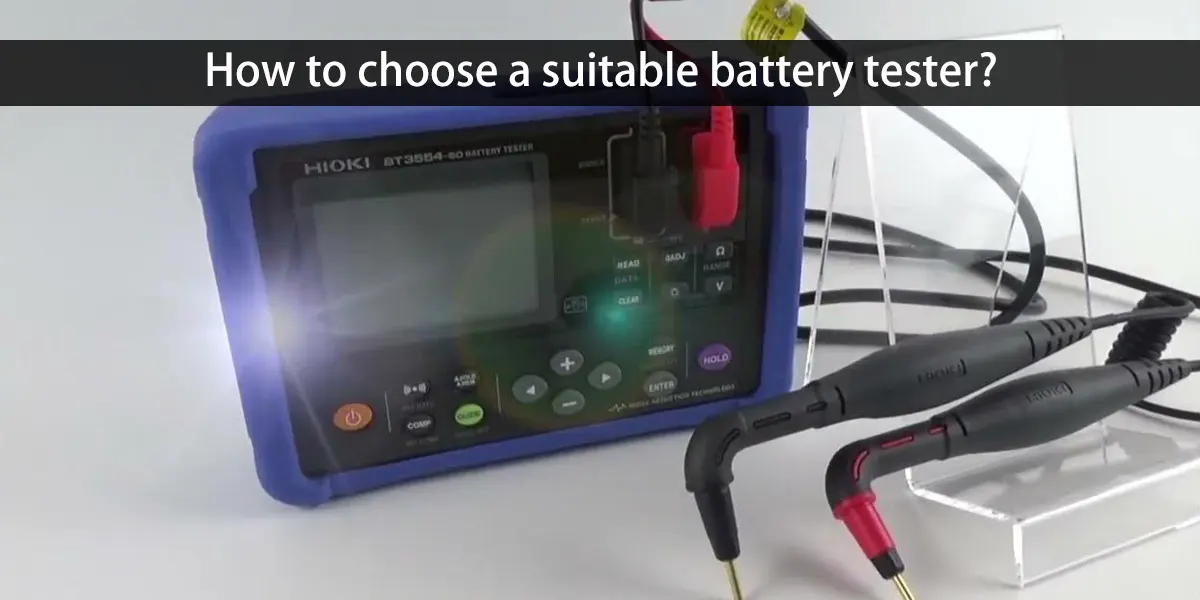
Evaluate Features and Functions: Look for additional features that may be useful for your applications, such as data logging capabilities, temperature compensation, auto-ranging, and compatibility with different battery chemistries.
Assess User Interface and Display: Ensure that the battery tester has an intuitive user interface and a clear display screen that provides easy-to-read measurement results.
Consider Portability and Size: Depending on your usage scenarios, consider the portability and size of the battery tester. Handheld testers are convenient for field use, while benchtop models may offer more advanced features but are less portable.
Check Compatibility and Safety: Ensure that the battery tester is compatible with battery capacity you’ll be testing. Additionally, look for safety features such as overvoltage protection and reverse polarity protection.
Read Reviews and Compare Brands: Research different brands and models of battery testers. Read reviews from other users to gain insights into their experiences and performance.
Budget Considerations: Determine your budget and compare the features offered by different models within your price range. Balance the cost with the features and functionality you require.
Consider Long-Term Support: Choose a reputable manufacturer that offers good customer support, warranties, and software updates to ensure long-term usability and reliability of the battery tester.
By following these steps and considering your specific testing needs, you can select a suitable battery tester that meets your requirements and helps you accurately assess the health and performance of your batteries.



 +86 – 18925002618





