



According to the working principle, it can be divided into three basic types: non-adiabatic, adiabatic, and isothermal.
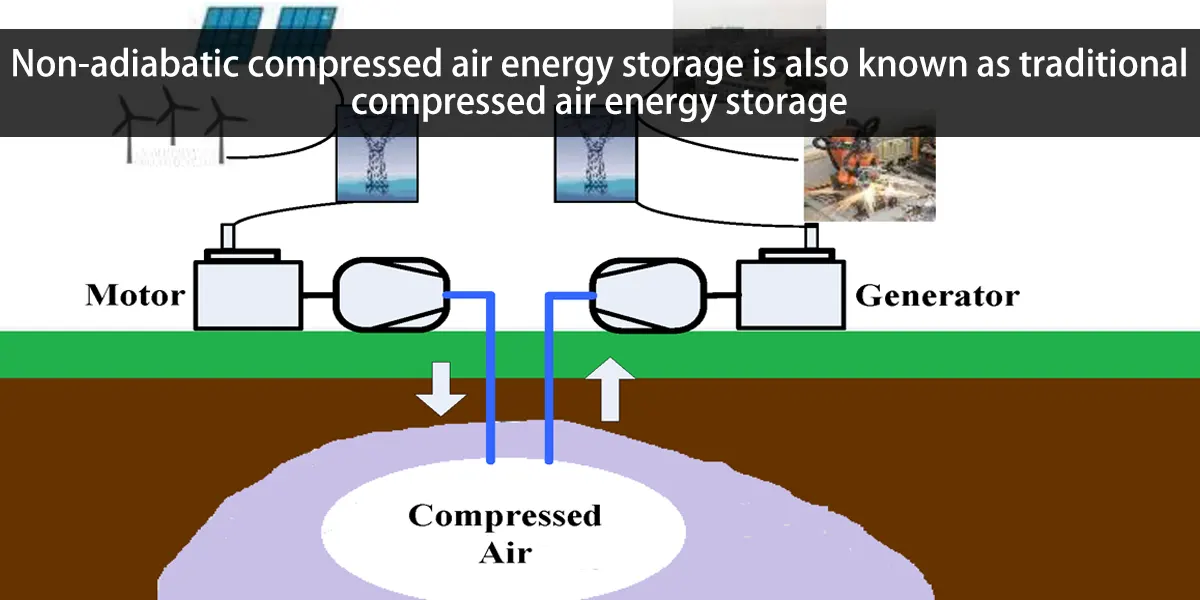
Non-adiabatic compressed air energy storage is also called traditional compressed air energy storage. It uses interstage cooling to improve compression efficiency during the compression process. The compression heat escapes directly to the environment. The energy release process relies on external heat sources or burning fossil fuels. Heated air. The early-construction 290 MW Huntorf power station in Germany and the 110 MW McIntosh power station in the United States both adopted this technical route. The gas storage pressure was about 4.6~7.5 MPa, and the system cycle efficiency was 42% and 53% respectively.
Adiabatic compressed air energy storage technology recovers compression heat through a heat storage device and stores it. It is used to repeatedly heat the air during the energy release process, making the compression and expansion processes similar to adiabatic processes without burning fossil fuels.
Ordinary adiabatic compressed air energy storage stores heat after the entire compression process, while advanced compressed air energy storage adds multi-stage heat exchange and heat storage. Although the system complexity and investment have increased, it also reduces compression power consumption. . The cycle efficiency of adiabatic compressed air energy storage systems is generally about 55% to 75%.
Isothermal compressed air energy storage system refers to using certain measures (such as liquid piston, spray, bottom air injection, etc.) to provide a nearly constant temperature environment through a liquid (water or oil) with a large specific heat capacity, thereby increasing the air-liquid contact area and contact time , making the air’s compression and expansion processes infinitely close to isothermal processes, minimizing heat loss. Here are more about solar battery storage systems.
Its theoretical cycle efficiency is more efficient than the first two types, reaching 70%~95%, but in practice it is difficult to achieve an efficient and cost-effective isothermal process, large-scale development is also very difficult, and the technology maturity is relatively low .
At present, the world’s only megawatt-level isothermal CAES (compressed air energy storage system) verification project was designed by SustainX, an American compressed air energy storage technology company, with a power of 1.5 MW and a test cycle efficiency of 54%.
Because non-adiabatic compressed air energy storage systems are inefficient and rely on external heat sources or fossil fuels, isothermal compressed air energy storage technology is immature, and the low energy density of the system hinders its large-scale application.
Judging from the current research and application results at home and abroad, new compressed air energy storage mainly focuses on the adiabatic technology route. Similarly, compressed CO2 energy storage also mainly focuses on the adiabatic technology route.
According to the storage state, there are mainly gaseous, liquid, supercritical and other types.
The main purpose of using liquid and supercritical storage is to increase energy storage density and reduce dependence on geographical conditions, but the price is the need to increase liquefaction cooling and gasification heating links, which increases the complexity of the system and additional energy loss.
The energy storage density of compressed air is generally 1~6 kW·h/m3, while the energy storage density of liquid air can generally reach more than 20 kW·h/m3. The world’s first liquid air energy storage commercial power station is located in the UK, with technology provided by Highview Power Company, with a scale of 5 MW/15 MW·h.
The company plans to build larger-scale LAES commercial power stations in Europe and Australia. China’s first domestic liquid air energy storage pilot project is a 500 kW/0.5 MW·h experimental prototype built by State Grid Global Energy Internet Group Co., Ltd. in Tongli, Jiangsu.
Generally speaking, liquid or supercritical compressed air energy storage technologies are still in the transition stage from scientific research demonstration to commercial demonstration.
Although CO2 is easier to liquefy and achieve supercriticality than air, unlike air that can be directly discharged to the environment after doing work, the CO2 energy storage system needs to consider both high-pressure gas storage and low-pressure (after energy release) gas storage.
It is easy to turn supercritical CO2 into a liquid state under high pressure by direct cooling at ambient temperature. The difficulty lies in how to liquefy low-pressure CO2.
The lower the pressure, the lower the liquefaction temperature required, and the higher the requirements for the refrigeration system or cold storage device, but improving The outlet pressure of the expander will reduce the external work, which is not conducive to the system cycle efficiency.
In addition, for complete supercritical CO2 energy storage, the low-pressure side pressure is also higher than the critical pressure. While maintaining a certain expansion ratio and output work, the high-pressure side pressure will be greatly increased. Generally, it needs to reach more than 20 MPa to provide CO2 high-pressure storage tanks. Manufacturing poses huge challenges.
Therefore, in the design of CO2 energy storage system, it is necessary to make a comprehensive trade-off in the determination of energy storage pressure and pressure after energy release, and the selection of low-pressure end gas storage and liquid storage solutions.
At present, the low-pressure end gas storage of CO2 energy storage laboratory projects that have been built at home and abroad all adopt the normal pressure gas storage method. Considering the future development towards larger scale, liquid or supercritical CO2 energy storage will undoubtedly be an important direction.

According to the gas storage method, compressed gas energy storage can be divided into three construction modes: ground energy storage, underground energy storage and underwater energy storage.
Ground energy storage uses metal pressure vessels or other material gas storage silos as gas storage devices; underground energy storage uses mines, salt caverns, aquifers, depleted oil and gas reservoirs or artificial caves as gas storage devices; underwater storage Artificial balls, gas storage tanks, etc. Clik here to get more about underground thermal energy storage.
On the bottom of the sea or lake can be used as gas storage devices. The choice of gas storage solution depends on environmental geographical conditions and technical and economic conditions.
Currently, most compressed air energy storage projects that have been put into production or are under construction use salt cavern gas storage. Salt cavern gas storage has the advantages of large capacity, high pressure, safety, reliability, and good economy, but it is restricted by salt cavern resource conditions.
Currently, there are many artificial chamber compressed air energy storage projects planned in China. However, because it is still in the early stages of application, its technical maturity, safety, and reliability require further engineering verification.
There are currently no successful applications of compressed gas energy storage using aquifers or depleted oil and gas reservoirs. The US PG&E (Pacific Gas and Electric) Company plans to build a 300 MW compressed air energy storage power station in California to use depleted gas reservoirs to store high-pressure energy.
Air has conducted an in-depth feasibility study and the project is still awaiting FID (Final Investment Decision). The compressed CO2 energy storage test projects that have been built so far are small in scale and use metal storage tanks and membrane gas storage silos to store high-pressure and low-pressure CO2 respectively. Underwater compressed gas energy storage is still in the theoretical research stage.
In addition, increasing the gas temperature at the inlet of the expander plays an important role in the output power of the expander. The compressed gas energy storage system coupled with an external heat source to supplement the heat can use external heat sources to increase the power generation capacity of air or CO2 and improve system efficiency.
Utilizable heat sources include solar energy, geothermal heat, waste heat from industrial enterprises such as metallurgy, chemicals, cement, glass and other industries, waste heat from power plants, etc. Here are more about top bess manufacturers.
The combustion heat of biogas, syngas, etc. produced from biomass can also be used, so this type Compressed gas energy storage systems have broad application prospects.
The compressed CO2 energy storage of the coupled heat pump system uses the heat pump to increase the system heat storage temperature and the expander inlet gas temperature, which is also one of the current hot research directions.



 +86 – 18925002618





