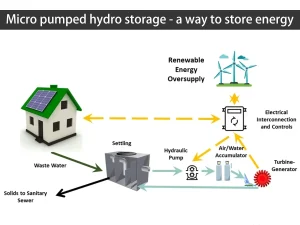
The core role of global energy storage is reflected in three aspects: frequency regulation, reduction of power curtailment and price difference arbitrage. In addition, energy storage has the advantages of black start and off-grid power supply.Â
1. The core role of energy storage
The essence of energy storage is a giant power bank. Under the new power system, unused energy is stored during periods when wind and solar resources are abundant, and energy is released to provide power during periods when resources are scarce and power consumption peaks, thereby achieving peak shaving and valley filling. In theory, it can reduce power abandonment and reduce electricity costs.
The core role of energy storage is reflected in three aspects: frequency regulation, reduction of power curtailment and price difference arbitrage. In addition, energy storage has the advantages of black start and off-grid battery power supply.
For example, in an extreme scenario where the entire regional power system collapses, the power supply can be restarted without drawing power from the grid.
2. Frequency regulation on the power generation side is the basis
The core of maintaining the stability of the power grid is to ensure the relative (dynamic) balance between power generation and power consumption. Frequency regulation is to adjust the frequency of the power system so that the change does not exceed the specified allowable range.
The output of wind power and photovoltaic power generation is determined by natural resources, with little human intervention, and the current prediction accuracy of wind and solar resources is relatively low. In the context of power system transformation, frequency regulation to ensure power quality has become particularly important.
Energy storage (especially electrochemical energy storage) frequency modulation has high requirements on speed and accuracy. Its AGC (automatic power generation control) tracking curve can basically be consistent with the command curve, and it can flexibly switch between charging and discharging states. To ensure accurate frequency adjustment. There will basically be no problems such as adjustment reversal, adjustment deviation and adjustment delay.
3. Grid side peak regulation is the core
Due to the natural attributes of wind and solar resources, there is little space for human intervention, the difference between peak and valley energy is large, and it does not completely match the power consumption period, which will waste a lot of resources during peak energy release.
For example, the output of wind power is at a high level from 21 to 5 o’clock the next day, while the electricity load is at its lowest at this time. The large amount of power curtailment has also affected the scale and economic development of wind and photovoltaic energy storage power.
The essence of reducing power abandonment is to store abandoned power and supplement the electricity load when the wind and solar output is low. “Storage” happens to be a giant power bank – the biggest use of energy storage.
Energy storage stores lower-cost electricity during peak discharge periods and uses low-cost electricity during low discharge periods to maximize economic benefits.
4. Arbitrage on the electricity side is an advantage
Under the influence of peak shaving and valley filling, energy storage can also realize arbitrage by selling excess electric energy. For example, the typical industrial and commercial energy storage economic model at this stage is to recover investment costs by obtaining income through energy time shifting, peak-valley price difference arbitrage, and capacity electricity fee reduction.
5. Current status of energy storage market development----China
The further increase in China’s power market demand and the increasing capacity and proportion of non-fossil energy installed power generation capacity will bring more room for development of energy storage market expansion.
As of the end of 2022, the installed capacity of new energy storage projects in China has reached 8.7 million kilowatts, with an average energy storage time of approximately 2.1 hours, an increase of more than 110% from the end of 2021.
Among them, judging from the proportion of newly installed technologies in 2022, lithium-ion battery energy storage technology accounts for 94.2%, still in an absolutely dominant position, and the newly added compressed air energy storage and flow battery energy storage technologies account for 3.4% respectively. %, 2.3%, the proportion growth rate has accelerated significantly.
In addition, various energy storage technologies such as flywheel, gravity, and sodium ions have also entered the engineering demonstration stage.
6. Development status of European and American energy storage markets
The rapid development of the energy storage market in Europe and the United States is mainly concentrated in the two fields of household storage and portable energy storage.
Europe and the United States are the main players in global household energy storage installations, each occupying about 1/4 of the market. The main driving factors for rapid development are the following:
- Affected by geopolitical factors, the energy self-sufficiency rate is low, and consumer electricity prices continue to rise, which promotes the increase in the penetration rate of household savings.
- The buildings are mostly low-floor independent buildings. The construction of energy storage installations is easy and the market demand is large.
- Due to the prevalence of outdoor culture and the disaster-prone geographical environment in some areas, portable energy storage is mainly used in European, American and Japanese countries.
7. Household energy storage
Professionalism and safety are the core competitive factors for integrators; one-stop complete after-sales service and brand owners are the key to high market share and long-term development.
It is expected that in the next 3-5 years, driven by policies to quickly achieve energy independence and affected by the expansion of the demand market, European behind the meter battery storage will maintain rapid growth. Under the development of power marketization, Solarpower Europe estimates that the number of new household installations in Europe in 2026 More than 10GWh.
8. Portable energy storage
It is mainly used in outdoor activities and emergency power, filling the gap between power banks and diesel generators. Product design and safety have become core elements of brand competition. At present, portable energy storage products have a higher penetration rate in European and American countries, and will maintain a growth rate of about 40% in the next five years.


+86 – 18925002618