What is mw and mwh in battery storage?
MW and MWh are standard units measuring different aspects of battery storage systems. A Megawatt (MW) is a measure of power that indicates how much energy a battery can produce at any point in time. That is, battery storage with a 4MW rating will produce up to a power of 4 megawatts.
On the other hand, the megawatt-hour (MWh) is a measure of energy that indicates how much electricity a battery can store and supply over a period of time. That is, a battery with 4 MWh of energy capacity can provide 1 MW of continuous electricity for 4 hours, or 2 MW for 2 hours, and so on. MW and MWh are important for understanding battery storage systems’ performance and suitability for different applications.
What is 1 mw battery storage?
A battery energy storage system having a 1-megawatt capacity is referred to as a 1MW battery storage system. These battery energy storage system design is to store large quantities of electrical energy and release it when required.
It may aid in balancing energy supply and demand, particularly when using renewable energy sources that fluctuate during the day, like sun and wind. Additional 1 MW battery storage advantages include increased power quality, less greenhouse gas emissions, and cheaper energy prices.
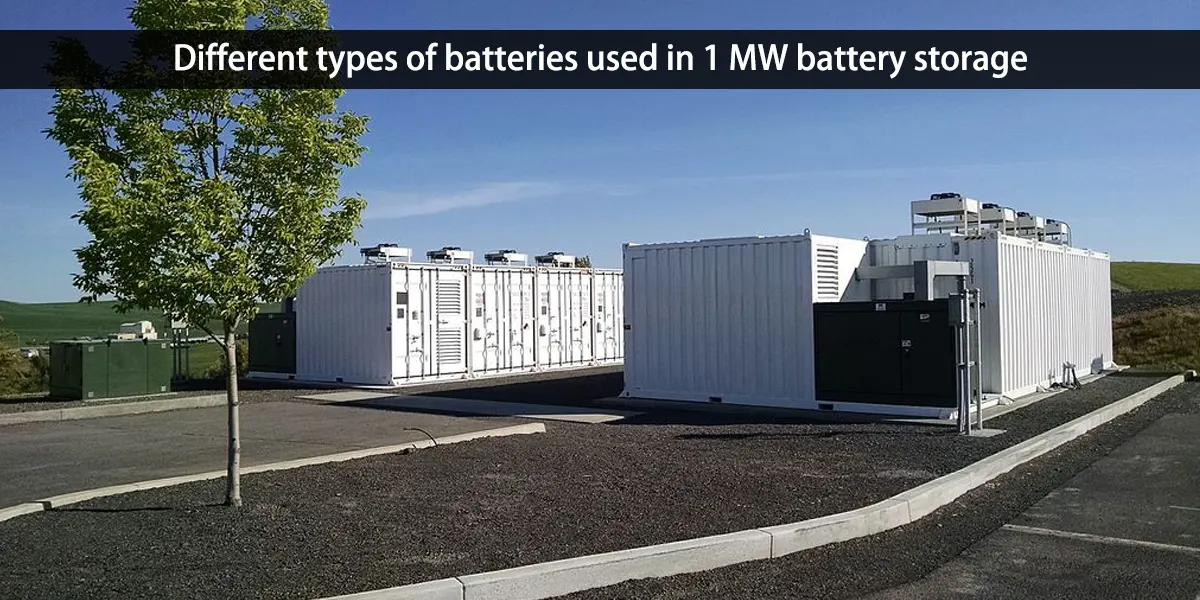
Battery packs, battery management systems, and power conversion systems are typical 1 MW battery storage components. These parts are tightly packed in a container and readily available to be moved to the point or location where they can be connected to the grid.
For 1 MW of battery storage, many battery types, such as lithium-ion, lead-acid, and flow batteries, are employed. Each battery type used in a 1 MW battery storage has advantages and disadvantages in terms of price, performance, and lifetime.
What does a 1mw battery energy storage system include?
● Battery racks and wiring: These components house the battery cells and link them in series or parallel configurations to provide the required voltage and capacity.
● Battery management system (BMS): This system monitors and regulates the efficiency and security of the battery cells. The battery BMS can continually monitor and modify a number of factors, including voltage, current, temperature, and charging status, to maximize battery life and performance.
● Power conversion system (PCS): The power system converts direct current stored in the battery to alternating current supplied to the grid. Likewise, it functions reversely and transforms grid-supplied AC to be stored as DC in the battery-safe. In order to meet grid needs, it may also adjust the frequency and voltage of the output power.
● Container: This is the building in which the 1 MW battery storage individual parts are kept. It might be a typical 20- or 40-foot container that can be linked to the grid. Other auxiliary elements in energy storage container may include heating, ventilation, air conditioning (HVAC), fire prevention, communication, and security systems.
What are the different types of batteries used in 1 mw battery storage?
● Lithium-ion (Li-ion) batteries: These batteries are the industry standard for energy storage. They have achieved unmatched importance in grid applications because of their exceptional characteristics, which include a high energy density, exceptional efficiency, and exceptional scalability. They are well-known for their ability to respond quickly, high power output, and long battery life cycle. Still, they are expensive.
● Lead-acid batteries: Lead-acid batteries are the most common and least expensive battery, with a long history of usage in various applications. Unfortunately, they have a short cycle life, poor efficiency, and significant maintenance requirements.
● Sodium-sulfur batteries: The sodium-sulfur batteries, which employ molten sodium and sulfur as electrodes, are another form of battery used in a 1 MW battery storage system. However, they come at a premium price and need constant thermal control and a strict safety routine.
● Zinc-bromine flow batteries: These batteries, which use zinc and bromine as their main electrodes, have a modest energy density and cycle life. They may offer a long-lasting discharge and independent power and energy scaling. However, costly and sophisticated and need pumps and piping.
What are the benefits of 1 mw battery storage?
● Peak Shaving: Battery storage saves surplus energy during times of low demand and releases it when demand for power surges. This reduces expenses for both customers and utilities while reducing the need for costly power plants only utilized during peak hours.
● Frequency Regulation: Consider battery storage to be a fast responder. It can adapt to variations in the electrical grid’s rhythm caused by changes in how much electricity is produced and consumed. It helps maintain the grid’s rhythm, which is critical for ensuring that the whole system runs smoothly.
● Energy Shifting: Battery storage offers a clever technique that transfers energy from periods when we produce a lot of clean electricity to periods when we don’t, and vice versa. This implies that we can utilize more renewable energy while consuming less fossil fuels, which is good for the environment.
By altering the electrical pressure and power at certain grid locations, 1MW battery storage acts as a guard for the power grid, which is crucial for ensuring the electricity is of high quality and efficiency. Adopting these changes lessens unpleasant power flickers and maintains a strong grid.
● Transmission and Distribution Support: 1MW battery storage can help us avoid the need to build more power lines and equipment. By placing batteries in areas where we consume a lot of energy, we can decrease traffic on power lines and reduce power losses. This improves and increases the reliability of our whole system.
How long can a 1 mw battery storage system power a facility?
The duration depends on several factors, such as the battery’s power and battery capacity, the facility’s load and demand, and the availability and cost of grid electricity. A simple way to estimate the duration is to divide the battery’s usable energy capacity by your facility’s average power consumption.
If you had a battery with 1 MW power and 4 MWh of useable energy, for example, you might extend your power output to 8 hours at 0.5 MW or 4 hours at 1 MW, and so on. However, this is the best-case scenario, and it ignores factors like battery efficiency, degradation, and how much energy is lost while the device is not in use. So, depending on the battery and how your location operates, the actual lifespan can be different.
What are the key factors to consider when selecting a 1 mw battery storage?
Let’s break down the key factors you need to think about when you’re planning to select a 1 MW battery storage system:
● What You’re Using It For: Before purchasing a 1 MW battery storage system, consider why you need the battery. If you want to assist in maintaining the electrical system stable, which 1 MW battery storage can achieve.
● How Much It Costs: The cost of a 1 MW battery storage system does not only revolve around the price of purchase. It is determined by how much it costs to purchase and install it, how much it costs to maintain it, and how long it will last.
● What Kind of Technology: Technology in this context refers to the kind of battery, and each battery has its own unique set of characteristics. Some can store a lot of energy, while others are very efficient.
● Where You’ll Put It: The location of the battery is important because it influences how you install it, operate it, and ensure it complies with the laws. The amount of space available, the weather, and how you connect it to the power grid all have a factor. Local laws and norms must also be followed, so make sure your setup is legal and safe.
What are the maintenance requirements for a 1 mw battery storage?
Regular Inspection and Testing
You should examine and test 1 MW battery storage systems on a regular basis to ensure their performance, safety, and dependability. Visually examine the battery racks, wiring, connectors, terminals, and containers as part of the inspection and testing. Also, check the battery voltage, current, temperature, and state of charge to see how much power remains.
Finally, verify the condition of the battery management, power conversion, and auxiliary systems to ensure everything is in its perfect state. How often you do this and how deep you go depends on what the manufacturer recommends and what your system requires.
Cleaning and Lubrication
1 MW battery storage systems should be cleaned and oiled regularly to avoid corrosion, dust collection, and overheating. So, get in there now and again and clean any dust off the battery cells, racks, cables, connections, terminals, and containers.
To safeguard the connections, you may also apply anti-corrosion products and make sure the container has enough ventilation to keep the air circulating. The frequency with which you do this is determined by the sort of battery you have, the environment it is in, and what the manufacturer recommends.
Replacement and Disposal
When 1 MW battery storage systems approach the end of their useful life or become damaged or malfunctioning, they should be replaced and disposed of responsibly. It’s time to replace it if you notice problems like decreased power, poorer efficiency, or damage. Remove the old battery cells, racks, cables, connectors, terminals, and containers.
Then, install the new ones and double-check that everything is properly connected. When you’re finished, make sure you dispose of the old battery components in accordance with your local laws and regulations. It’s similar to recycling an old automobile part after you purchase a new one.
The 1-megawatt power unit is used to quantify electrical production or consumption. A 1 megawatt may power various devices depending on their nature and efficiency. This amount can, for example, power about 814 US houses for one hour, an electric car for 3,600 miles, two 60-watt lightbulbs for a year, an average residential pool pump for five months, and two contemporary refrigerators for a year.
The number of batteries required for 1 MW battery storage is determined by their kind, size, and arrangement. Different battery types have varying energy and power densities, which determine how much electricity they can store and provide. As a result, the actual quantity of batteries may vary based on the system's features and circumstances.
Yes, depending on the design and configuration of the system, a 1 MW battery storage system may be increased in the future. Some battery storage projects have been or are being expanded.


+86 – 18925002618