


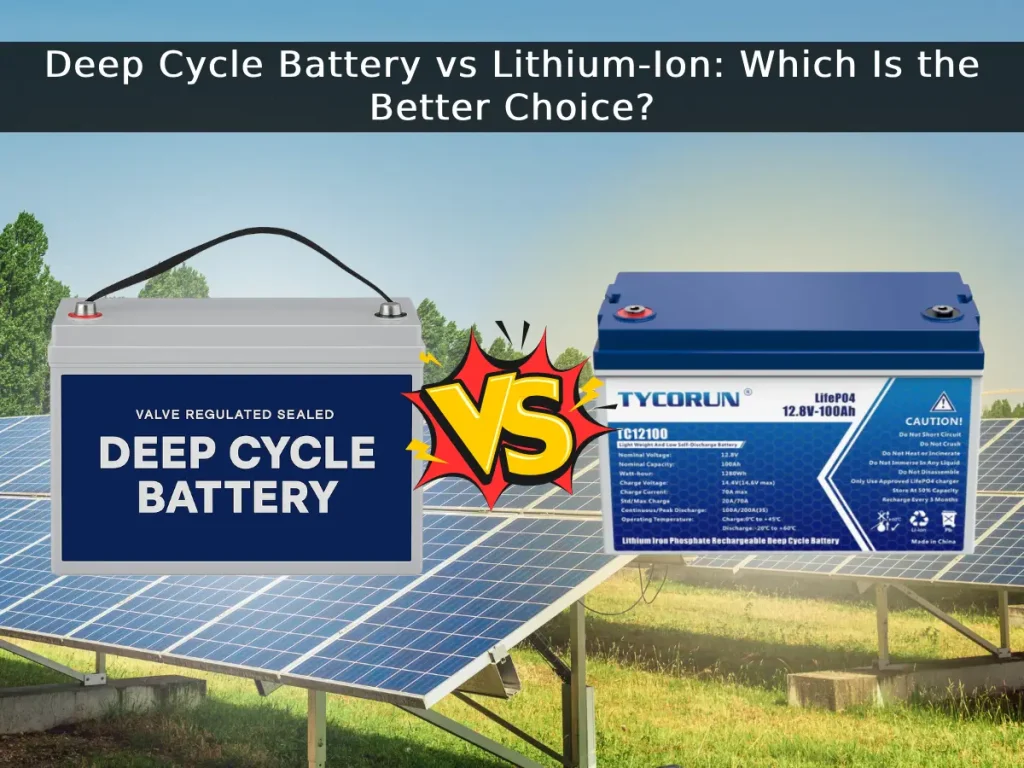
Choosing a battery for an energy storage system should not be made arbitrarily. This is because in energy storage, batteries play a role in storing electrical energy that has been generated from power sources such as solar panels, wind turbines, or grid electricity backup. Therefore, users need to choose the right battery for use at home, in the office, or for business purposes.
When selecting batteries for energy storage, a frequently discussed topic is deep cycle battery vs lithium-ion. Both types of batteries can be used for energy storage systems, but they operate differently. So, which battery is most suitable for users?
This article explores the topic deep cycle battery vs lithium-ion. Users will understanding how each type works and it also helps users to decide which battery is more suitable for specific energy needs.
Understanding Deep Cycle Battery
Before we discuss further about deep cycle battery vs lithium-ion, it is important for users to first understand what a deep cycle battery is. A deep cycle battery is a battery that is designed to be used repeatedly. This battery has a depth of discharge (DoD) of around 50-80%. This means that this type of battery can withstand multiple charge and discharge cycles.
In energy storage systems, deep cycle batteries are usually used to store electricity generated from solar panels or grid electricity backup. There are several types of batteries, such as:

- Flooded Lead-Acid (FLA)
FLA battery is a deep cycle battery that is the most affordable among other batteries. However, this battery still requires routine maintenance to check the battery and refill the electrolyte water. An FLA battery is a deep cycle battery that is the most affordable among other batteries. However, this battery still requires routine maintenance to check the battery and refill the electrolyte water.
For a deeper understanding, check out our guide on lead acid battery capacity - Absorbent Glass Mat (AGM)
Then there is the AGM type, which has a more modern design because it is classified as a maintenance-free battery. This type of battery uses a glass mat separator that holds the electrolyte, making it safer and more practical. - Gel Battery
Gel battery is also classified as a maintenance-free battery. Gel battery has almost the same design as AGM, except that the electrolyte inside is in gel form. This design makes the battery more resistant to extreme temperatures and more stable for long-term use.
Understanding Lithium-Ion Battery
After discussing deep cycle battery, users will surely ask what lithium battery is. Lithium battery is a more modern type of battery compared to deep cycle battery. This battery uses Lithium-ion material which gives it many advantages. For example, this battery is very light and compact in size. However, even so, this battery has high energy density, so it can still store more power in its small size.

In energy storage systems, this type of battery is very popular and widely used. This is because lithium battery has a greater Depth of Discharge (DoD) than deep cycle battery. So, lithium battery can still be used until its capacity is almost discharged without being easily damaged. Lithium battery is also a maintenance-free battery, making it more practical for everyday use. This comparison is often discussed in the topic of deep cycle battery vs lithium-ion when choosing an energy storage solution.
Learn more in our article on What is lithium-ion battery storage?
Key Differences Between Deep Cycle Battery vs Lithium-Ion
In understanding the topic of deep cycle battery vs lithium-ion, it is important for users to know the differences between these two batteries. Although both batteries can be used for energy storage, users must know the characteristics of each battery.

- Technology & Design
In terms of technology and design, lithium batteries are far superior to deep cycle batteries. Deep cycle batteries are usually still lead-acid based, which makes them heavier and require routine maintenance. Meanwhile, lithium batteries use the latest technology and design, making them more compact, lightweight, and maintenance-free. - Efficiency & DoD
In the topic of Deep Cycle Battery vs Lithium-Ion, lithium batteries are also clearly superior in terms of efficiency and DoD. This is because lithium batteries have a higher DoD compared to deep cycle batteries, which are more limited. As a result, deep cycle batteries still require supervision when in use so that they are not frequently drained completely. - lifespan
Lithium batteries have a longer service life of up to 10 years. Meanwhile, deep cycle batteries usually have a service life of around 3–5 years
Performance and Lifespan: Deep Cycle Battery vs Lithium-Ion
When users choose batteries for energy storage, they must consider the performance and lifespan of deep cycle battery vs lithium-ion battery. These two types of battery have noticeable differences in terms of lifespan and performance. But before we get into the comparison, do you know what battery efficiency is? Battery efficiency is how much electrical energy enters the battery and can be used again when discharged.

Deep cycle battery efficiency is around 70-85%. Meanwhile, lithium battery efficiency is higher, reaching up to 95%. So, if users input 100 watts into each battery, the results will be different. With a deep cycle battery, only around 70-85 watt-hours can be reused, with the rest lost. Meanwhile, lithium battery can be reused almost entirely.
Now that users understand the efficiency of both deep cycle battery vs lithium-ion, what about the lifespan of these two batteries? The answer is that lithium battery has a longer lifespan of up to 10 years, compared to deep cycle battery which only lasts 3-5 years.
Covered this in detail in How to Discharge Batteries?
Cost Comparison: Deep Cycle Battery vs Lithium-Ion
In understanding the topic of deep cycle battery vs lithium-ion, it is also important for users to consider the cost of these two batteries. Here is a comparison of their costs

- Deep Cycle Battery
For deep cycle battery types, users can easily find these battery in the market at a more affordable price. However, after installing a deep cycle battery, users also need to consider the routine maintenance of this battery. One of the most well-known deep cycle batteries is the lead-acid battery, which still requires regular maintenance to check and refill the electrolyte fluid. - Lithium-Ion Battery
Lithium-ion battery is a battery that uses more modern materials and technology and is classified as a maintenance-free battery. Additionally, this type of battery has a longer lifespan compared to deep cycle battery. Therefore, this aligns with the higher initial cost users will incur compared to regular battery.
Pros and Cons of Deep Cycle Battery vs Lithium-Ion
Each battery has its own pros and cons for storage systems. Therefore, when understanding the topic of deep cycle battery vs lithium-ion, it is important for users to understand the pros and cons.

Pros of Deep Cycle Battery:
- Deep cycle batteries are cheaper than lithium batteries.
- They have been proven to be durable in various energy storage applications.
- They are suitable for short-term needs or if you have a limited budget.
Cons of Deep Cycle Battery:
- They have a shorter lifespan, averaging only 3–5 years.
- Their efficiency is lower, at around 70–85%.
- Requires regular battery maintenance, especially the Flooded Lead-Acid type.
- Deep cycle batteries are heavier and larger in size.
Pros of Lithium-Ion Battery:
- Very high efficiency, up to 95%.
- Long service life, exceeding 10 years.
- Lithium batteries are designed to be lighter, more compact, and require less maintenance.
- They have a deeper depth of discharge (DoD) without causing rapid damage.
Cons of Lithium-Ion Battery:
- The initial price is quite expensive.
- They require a battery management system (BMS) to remain safe and durable.
Which One Should You Choose for ESS Applications?
Once users understand the topic of deep cycle battery vs lithium-ion, the next step is to match the battery choice to the energy storage system requirements. Here is a simple guide:

- Choose a Deep Cycle Battery
Deep cycle batteries are suitable for users looking for an option with a more affordable initial price. This type of battery is typically used in small systems or emergency backup applications that are not used very often. However, users also need to consider that this type of battery requires regular maintenance and has a relatively shorter lifespan. - Choose a Lithium-Ion Battery
Lithium batteries are a good choice for users who need high performance and want a practical solution without regular battery maintenance. Additionally, because lithium batteries have a long service life, high efficiency, and high depth of discharge, they are ideal for long-term investments in energy storage systems.
Curious to know more? See our explanation of lithium deep cycle battery here.
Conclusion
When choosing a battery for energy storage, the comparison that is often discussed is deep cycle battery vs lithium-ion. Both batteries can be used in energy storage systems, but they have different working methods and characteristics.
Deep cycle batteries are better known as classic batteries with more affordable prices. This type of battery is very suitable for small systems or small power backups. Meanwhile, lithium-ion batteries are equipped with more modern technology, use more efficient materials, and offer much longer performance and service life.
However, ultimately, the choice of battery needs to be personalized to the user’s decision. If the user wants a cost-effective solution initially, they can choose deep cycle batteries, or if they want a more practical and durable long-term investment, they can choose lithium-ion batteries.
FAQS
Lorem ipsum dolor sit amet, consectetur adipiscing elit. Ut elit tellus, luctus nec ullamcorper mattis, pulvinar dapibus leo.
Generally, lithium-ion batteries are considered safer when using stable chemistries like LiFePO4. They have built-in management systems (BMS) that protect against overcharging, overheating, and deep discharging, making them more reliable than traditional deep cycle lead-acid batteries.
Generally, lithium-ion batteries are considered safer when using stable chemistries like LiFePO4. They have built-in management systems (BMS) that protect against overcharging, overheating, and deep discharging, making them more reliable than traditional deep cycle lead-acid batteries.



 +86 – 18925002618





