



A 20-foot liquid-cooled battery cabin using 280Ah battery cells is installed. Each battery cabin is equipped with 8 to 10 battery clusters. The energy of a single cabin is about 3MWh-3.7MWh. You can click our liquid cooling vs air cooling to get more information about cooling.
The newly launched 5MWh+ battery compartments using large-capacity cells such as 305Ah, 314Ah, 315Ah, and 320Ah are generally integrated based on 20-foot cabins, and the double-door design is still the mainstream model.
However, a small number of units, such as Sungrow, have adopted a single-side door opening design to further increase the energy density of the energy storage system.
According to industry experts, most of the 5MWh+ battery cabins adopt centralized topology and liquid cooling and heat management. There are 12 battery clusters in the whole cabin. The DC sides of the battery clusters are connected in parallel and then connected to the DC side of the PCS. The energy of a single cabin can reach more than 5MWh.
Compared with the mainstream 20-foot 3.72MWh energy storage system, the 20-foot 5MWh energy storage system has a 35% increase in system energy.
Calculating the initial investment cost based on a conventional project capacity of 100MW, the large-capacity standard 20-foot 5MWh liquid-cooled energy storage system saves 43% of the area and 26% of the cost compared to the mainstream 3.72MWh product.
Compared with the mainstream 20-foot 3~4MWh energy storage system, the 5MWh+ energy storage system has greater energy density and reduces the floor space; due to the use of large battery cells, the number of BMS is relatively reduced, but the required balancing current is relatively large; EMS There is no essential impact, it is just a reduction in monitoring cell data.
Taking CATL’s “Ener Series” as an example, the energy of a single cabin has been increased from the existing 3.354MWh to 5.016MWh, and the energy density has been increased by about 50%. This can effectively save floor space and reduce the comprehensive investment cost and station power consumption of energy storage power stations.
Improving energy density is one of the main ways to reduce the cost of energy storage equipment. According to calculations by industry experts, the capacity of a 40-foot battery cabin has increased from 2.5MWh per cabin in 2018 to more than 10MWh now.
The energy density of the energy storage battery cabin has increased by about 4 times, and the cost of DC side equipment has also been reduced from about 2 RMB/Wh to The current price is around 0.8 RMB/Wh.
First, after the system capacity is upgraded, the PCS power unit will also be iteratively upgraded simultaneously.
At present, mainstream PCS manufacturers generally use PCS with rated capacities of 1725kW, 1500kW, etc., combined with transformers of about 3000~3600kVA to form power units.
It is predicted that in order to match the application of 5MWh+ battery compartment, PCS manufacturers in the future are expected to use PCS with a single unit rated power of 2500kW and a transformer of about 5000kVA, thereby increasing the power density of the entire station.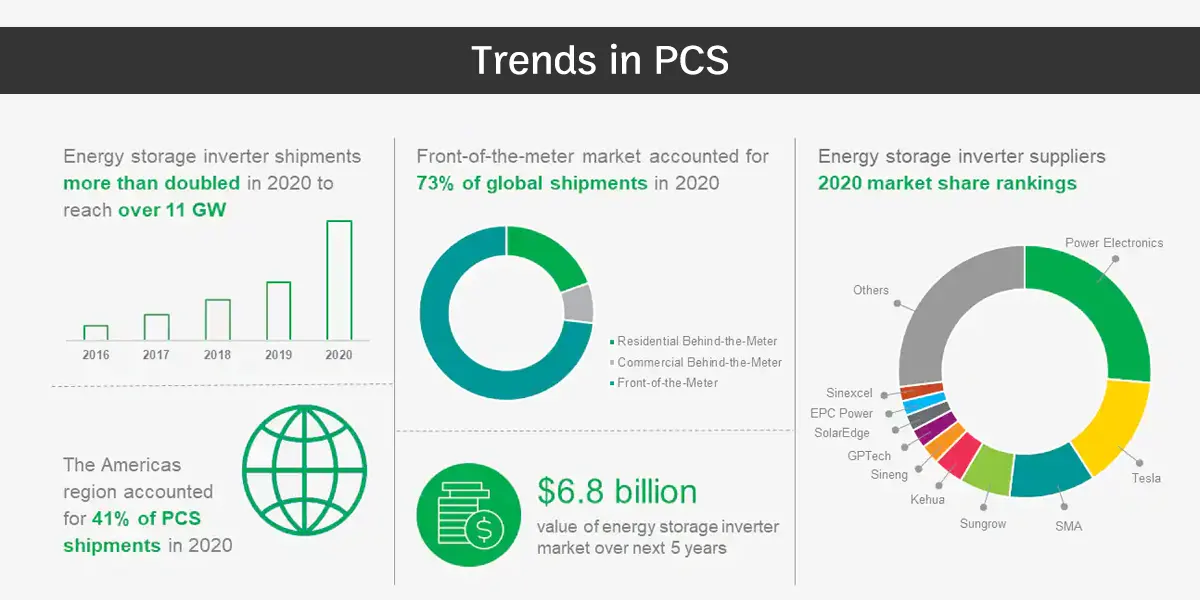
With the increase in power and energy density of 5MWh+ energy storage systems, at least five key requirements are put forward for integration capabilities.
1. Battery consistency and balancing ability between battery clusters
As the number of battery clusters connected in parallel increases, the circulation problem of 5MWh+ energy storage equipment will intensify. In addition, 5MWh+ energy storage equipment generally adopts a centralized topology.
The battery clusters are directly connected in parallel at the DC side bus. Circulation problems will cause accelerated cycle life degradation and even pose safety risks. Therefore, how to improve battery consistency and balancing capabilities among battery clusters will become key.
2. The heat dissipation performance and temperature balancing ability of the battery core
As the energy density of batteries and battery compartments increases, heat dissipation issues will become more prominent. Currently, indirect liquid cooling and heat management methods are commonly used in battery compartments. The ethylene glycol aqueous solution flows through the cold plate at the bottom of the battery PACK to exchange heat for the battery cells.
Although the concept of immersion liquid cooling has become popular, it is still in the “acclaimed but not popular” stage due to its own reasons.
But for 5MWh+ energy storage equipment, how to improve the heat dissipation performance and temperature balancing capabilities of the battery core is crucial, and immersed liquid cooling is expected to see greater penetration. For example, increase the number and accuracy of battery PACK temperature sensors, increase the cooling efficiency of liquid cooling units, etc.
According to calculations, a 20-foot 5MWh liquid-cooled energy storage container using 314Ah batteries requires more than 5,000 batteries, which is 1,200 fewer batteries than a 20-foot 3.44MWh liquid-cooled energy storage container using 280Ah energy storage batteries.
Then, in specific energy storage fields with high safety requirements such as commercial buildings, airports, ports, and rail transit, immersed liquid cooling can have better application prospects.
3. Fire safety – pack level fire protection
In battery energy storage system design, higher energy density puts forward higher requirements for fire protection design, including water fire protection, gas fire protection, early warning detection and exhaust design, etc. Safety design cannot be reduced due to the increase in energy density.
In fact, due to the relatively high protection level of liquid-cooled PACK, which generally reaches IP67 and above, the use of PACK-level fire protection methods will be an industry trend.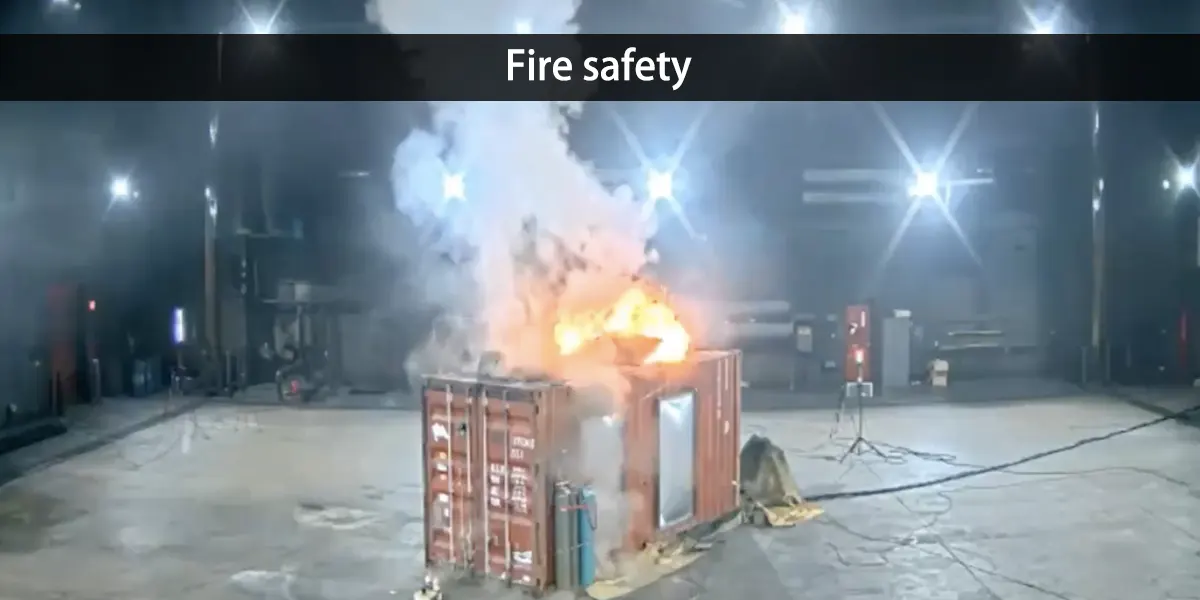
However, at this stage, most pack-level fire protection system equipment is not fully mature. There is no market supervision and management mechanism, and there are many difficulties in later operation and maintenance of product reliability.
As the use of 5MWh+ battery cabins accelerates and becomes mainstream, improving detector detection accuracy, reliability and fire protection system linkage measures will also become key areas in the industry.
4. Fire and explosion-proof design, fire isolation and operation and maintenance of the entire site
Currently, for safety reasons, liquid-cooled battery compartments are designed to be non-walk-in. When designing the structure, the fire and explosion-proof design of the battery cells, battery modules, battery clusters, and cabins need to be considered.
For example, the partitions between battery clusters need to meet certain fire resistance time requirements, and the cabins should be equipped with explosion vents to reduce the scope of the accident.
5MWh+ energy storage equipment leads to the design of long modules and large packs. The larger packs pose greater challenges to the pack’s structural strength, heat dissipation temperature distribution, and safety design.
In the layout of the entire site, it is necessary to reasonably divide the energy storage area based on fire protection zoning, electrical wiring, operation and maintenance, etc., and divide the fire protection area by setting fire protection distances or firewalls.
In terms of operation and maintenance, how to satisfy heat dissipation without reducing the customer’s wiring and operation and maintenance space also poses a great challenge to product design.
5. Short-circuit current withstand capability of DC side switching equipment
The number of parallel battery clusters on the DC side of the 5MWh+ energy storage system has increased from the current 8 to 10 clusters to 12 clusters, and the DC side short-circuit current will increase compared to the previous generation system.
Compared with AC, DC short-circuit current is more difficult to extinguish arc. Therefore, when a short circuit occurs on the DC side of the energy storage unit, higher conditions are put forward for the selection of DC side equipment.
According to research, the current short-circuit current has exceeded the breaking capacity of existing DC circuit breakers. Therefore, under the trend of 5MWh+ battery compartments, the use of DC fuses as DC side protection breaking equipment may become an inevitable choice. At the same time, attention must also be paid to the short-circuit current withstand capability of the DC side switching equipment.



 +86 – 18925002618





